
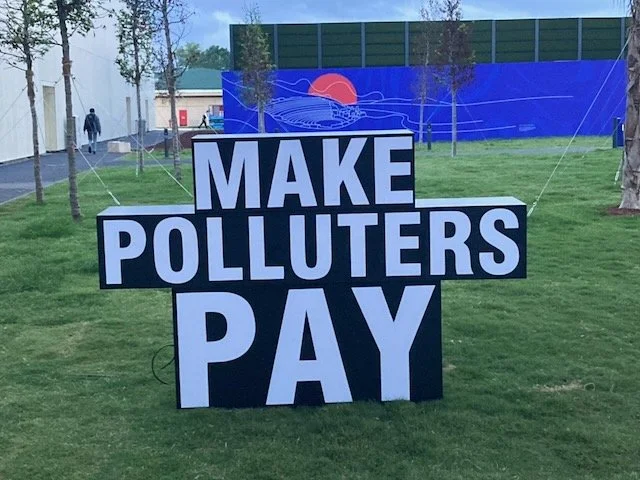
A sculpture at the COP 31 venue in Antalya, Türkiye reads "Make Polluters Pay."
By Sarah Schumann
November 26, 2026 — Happy Thanksgiving to my fellow Americans! May your bellies and hearts be full today. I’m not in the U.S. right now, so while you toil in aromatic kitchens over succulent turkeys and sugary pies, I am taking this opportunity to write up some personal reflections on the battle taking place on Capitol Hill over the Bipartisan American Affordability and Jobs Act (BAAJA).
The text of BAAJA is not something to be thankful for; nor is the fact that it passed the Senate last week. But the upwelling of opposition to this bill that has occurred in the past two months is indeed something to celebrate, and its affirmation of what so many Americans hold dear — clean and abundant water, a livable climate, wild places and open spaces, respect for local communities and Tribal sovereignty, and a strong commitment to a fully functioning democracy — is as divine as the most copious Thanksgiving feast. In this blog, I describe the breadth of this magnificent outrage, and then reflect on what it means for members of the commercial fishing community, who have for too long been absent from multi-constituency organizing around climate and environment issues.
Before I share my thoughts, I want to remind readers that the Fishery Friendly Climate Action Campaign is not a coalition or an entity, but rather a loosely cohesive collection of actions taken by members of the US commercial fishing community to advance climate action that these members consider “fishery friendly.” Although I am the director of this Campaign, I do not speak for it or for other members of the fishing community. This blog expresses the views of a single commercial fisherman: me.
The bill and its backers
BAAJA is the latest in a series of bills proposed since 2022 that have aimed to reduce permitting approval times for electrical grid transmission infrastructure, oil and gas pipelines, and other large-scale development projects favored by one party or the other. It was introduced in the Senate on September 30 by two Democrats (Sheldon Whitehouse of Rhode Island and Martin Heinrich of New Mexico) and two Republicans (Mike Lee of Utah and Shelley Moore Capito of West Virginia). Over 400 pages in length, it passed the Senate on November 19 by a 62–33 vote.
BAAJA would amend the National Environmental Policy Act (NEPA), Clean Water Act, Endangered Species Act, and National Historic Preservation Act, among others. For the most part, these changes are designed to speed up project permitting — in part, by curtailing public input and Tribal consultation while reducing the scope for affected parties to bring lawsuits. While some Democratic proponents are selling the bill as win for a clean energy, the bill would in fact ease permitting across a broad range of energy, infrastructure, and large-scale development projects, including high-voltage transmission lines, power plants, renewable energy (such as wind and solar), geothermal energy, natural gas pipelines, data centers, mines and other forms of mineral extraction, and highway projects.
The bill’s highly controversial Section 1401 would improve “project certainty” for developers by making it much harder (or impossible) for federal agencies to revoke, rescind, suspend, or materially amend permits once they have been granted. Its equally controversial Section 1402 would authorize project developers to sue federal agencies over “unreasonable” permit delays or permit denials that could be perceived as evidence of "disparate treatment.” Opponents worry that, if BAAJA becomes law, fossil fuel developers could sue future administrations for allegedly discriminatory permitting practices if they systematically grant permits to clean energy projects while delaying or denying permits for comparable fossil fuel projects, potentially exposing taxpayers to substantial damages while failing to meet the urgent need to decarbonize the U.S. economy.
The bill’s proponents include President Trump, the American Petroleum Institute (which has been trying to raise enthusiasm for the bill by handing out free tacos near the Capitol), some climate advocacy groups (e.g., Citizen’s Climate Lobby, who believe that if policy makers put clean and dirty energy on an even playing field, clean energy will win out because wind and solar are now cheaper than coal and gas), unions (e.g., the AFL-CIO), investor-owned electrical utilities, and clean energy trade groups (e.g,. the Solar Energy Industries Association). Opponents of the bill (who are described later in this blog) have pointed critically to its many perks for the artificial intelligence (AI) industry, whose energy-intensive data centers have faced intense community opposition. Some opponents have drawn attention to the synchronicity of the bill’s Senate passage with the much-touted initial public offering (IPO) of Anthropic, the company behind the Claude family of AI models; in fact, both events took place on the same exact day.
The bill now awaits discussion and a vote in the House of Representatives, a step that is predicted to commence when the House Rules Committee convenes at 4:00 pm on Monday, November 30. If the bill’s proponents have their way, BAAJA would be passed by both legislative chambers and signed into law by the president before the end of the 119th Congress on January 3, 2027. Otherwise, the bill will expire and would need to be reintroduced into the incoming 120th Congress, which has a very different partisan make-up, and may therefore face a steeper battle when it comes to obtaining President Trump’s sign-off on a permitting bill.
Grassroots opponents mobilize
Since BAAJA emerged on the scene two months ago, the bill has managed to rack up an impressive list of fervent enemies. The Natural Resources Defense Council (NRDC) wrote “the bill goes too far in weakening essential environmental safeguards and opportunities for public participation.” The Western Environmental Law Center calls it “the most damaging environmental and community protection rollback in American history.” The Climate Justice Alliance wrote, “this legislation will benefit the largest fossil fuel polluters, explode the approval of data centers, and enrich tech billionaires, entrenching communities with more pollution, harm, and higher bills.” EarthJustice alleged that the bill “would profoundly chill federal enforcement of our pollution control laws.” A letter signed by over 200 climate scientists stated, “We understand the need for trade-offs and compromise when passing bipartisan legislation. But as scientists we feel strongly that the costs of this bill to the climate are too high.”
The NAACP condemned BAAJA as a bill “aimed at expediting permitting reviews to power big energy projects like data centers,” and asserted, “A more just approach to permitting requires building from the ground up with community protection at its core, a foundation that BAAJA fundamentally lacks in any form.” The National Congress of American Indians concluded, “Congress must reject BAAJA in its entirety. Native sovereignty, sacred places, and cultural heritage are not negotiable.” The Archaeological Institute of America wrote that BAAJA “destroys America’s historic places and archaeological sites, guts public involvement, and strips stakeholders like Native tribes and taxpayers of their right to weigh in on federally backed projects.”
A letter signed by over 100 legal scholars quipped, “BAAJA is sold as a climate compromise. It is nothing of the kind. It trades near-term, concrete, and often irreversible harms, borne first by low-income, Tribal, and frontline communities, for climate benefits that are distant, modest, and uncertain.” Equally damning, the legal scholars slammed the process that led to the Senate’s passage of the bill: “A bill that would permanently restructure judicial review, Tribal consultation, and state water quality authority demands a record. This one has none: no hearing, no markup, no committee report. It rides on H.R. 2347, an unrelated tax bill. The 575 federally recognized Tribal Nations and the public had roughly two days to absorb a 494-page substitute before the November 9 cloture vote. Courts, not Congress, will be left to decide what it means.”
Even the beer brewing industry opposes BAAJA.
High profile individuals in the climate movement are singing the same tune. Bill McKibben, Ayana Elizabeth Johnson, and Al Gore have come out against BAAJA. Former Biden administration climate advisor John Podesta said the bill’s permitting certainty provisions amount to “handing Trump a loaded Howitzer” to push through dirty fossil fuel infrastructure investments that the climate and the public will be forced to live with for decades.
According to an article in Heatmap News called “The Climate Coalition Is Threatening to Split Apart,” the rift between clean energy companies (who broadly back the bill) and civil society environmental groups (who mostly oppose it) marks a sea change in the landscape of U.S. climate politics. “As the clean energy industry has grown,” the article comments, it has become less dependent on the environmental movement for support and “has come to share the fossil energy industry’s preference for more permissive regulatory regimes and fewer environmental protections.” Meanwhile, the environmental movement has skewed in a more progressive direction thanks to pressure by its environmental justice flank: “The movement has now coalesced, however incompletely, around a broader and more inclusive environmental vision.”
I will admit to feeling some satisfaction about this realignment. People like myself felt a bit excluded from the climate/clean-tech coalition of the last half decade. Our insistence that clean energy projects meet the same environmental standards — and be just as attentive to local concerns — as any other energy source were often mischaracterized as climate obstruction, and our demands for good public policy misconstrued as climate delay.
In contrast, I felt affirmed last week when climate and energy analyst Danny Cullenward posted on Bluesky — prompted by BAAJA backers’ disparagement of BAAJA opponents — “Climate justice friends: When some of you told me that harmful policy would be rammed down the throats of overburdened communities in the name of climate urgency, I was reluctant to believe that people in my coalition would ever do such a thing so purposefully. You were right.”
A place for the fishing community?
The conglomeration of people and entities that have coalesced in their opposition to BAAJA has started to refer informally to their emerging coalition as “the groups” — a moniker that was initially used pejoratively by BAAJA backers wishing to disparage the bill’s opponents but is now being embraced by opponents as an embodiment of their emerging coalition’s heterogeneous and grassroots nature. Is there a space for the commercial fishing community within this big tent?
People who fish for a living are exposed to harm from many forms of infrastructure and energy development, and we don’t fall neatly along the “clean versus dirty” energy divide. Let’s get one thing clear: we’re well acquainted with the dangers of fossil fuels. Fishing communities have paid a colossal price every time an offshore oil spills occur, and there’s not a fisherman on Earth who’s not already (or who won’t soon be) affected by the oceanic impacts of global warming. But at the same time, the direct impacts of offshore clean energy development may equal or exceed the negative impacts of climate pollution at local levels, and when public input and environmental review of these projects are rushed or corrupted by powerful corporate interests, it is fishermen who take the hit. As a result, fishing communities were among the most outspoken critics of the Biden administration’s approach to offshore wind, and many rejoiced when President Trump revoked or suspended offshore wind leases — the very kind of move that BAAJA’s backers seek to prevent through the bill’s permitting certainty provisions.
But there’s more. Fishing communities have long stood on the front lines of mining proposals in anadromous watersheds, and we are increasingly wary of corporations’ designs to extract minerals from the seabed as well. Nor are we immune from the impacts of data centers, which can usurp river flows needed to support anadromous fish passage in water-limited regions. There are even underwater data centers proposed in Alaska and Maine.
In short, all forms of development can impact fishery-supporting ecosystems. As a result, fishermen are not likely to side with one type of development over another. But we are likely to support strong and sensible environmental and climate laws that put food security, local economic and cultural wellbeing, and sound and transparent public engagement at their core. BAAJA is none of these things, and that’s why fishermen have been lobbying hard to oppose it.
The climate movement of the last decade lionized water protectors at Standing Rock while painting my colleagues in the fishing community as enemies of climate progress. Why? Because the extractive corporate infrastructure in the first instance was a crude oil pipeline, and in the second instance, offshore wind farms — which were granted a free pass in the pursuit of “speed to power” by many climate warriors who were basking in the rosy glow of a long-awaited clean energy revolution.
What the fight around BAAJA hopefully makes clear is that all communities want to protect the places they love from rampant development, regardless of the nature of that development, and they all deserve a sound and steady public process with strong environmental safeguards that gives them agency in decisions that affect them. The BAAJA debate should also be viewed as an affirmation that all developers want to drill, build, or mine as fast as possible and with minimal community and environmental friction, and it is the job of laws and civil society groups to hold them accountable to the better angels of their nature. If the emerging anti-BAAJA movement can accept these basic tenets, then I very much look forward to introducing its members to my friends in the fishing community.
The urgency of getting it right
As I write this, the planet has clocked a new record, with six consecutive days of temperatures 2C warmer than preindustrial levels. Record-high king tides, amplified by a powerful El Niño, are hammering infrastructure along the California coast while New Yorkers and New Englanders endure a Thanksgiving Nor’easter that has postponed the famed Macy’s parade and upended many families’ dinner plans. More seriously, floodwaters are swallowing the Brazilian state of Minas Gerais, with eight people among the casualties so far. And that’s just this week alone.
But as climate and energy analyst Ketan Joshi wrote in a 2023 blog essay, “It is because climate action is so urgent that we should be careful with how we roll out clean energy.” That essay, titled “Nature and people shouldn’t be designated losers in the energy transition,” recently began making rounds again in response to BAAJA, and in many ways it could be the BAAJA opposition’s manifesto. “We need speed, yes,” Joshi’s essay concludes, “but we also need to maintain speed. Sacrificing the latter to achieve the former results in failure.”
How to take action
The House of Representatives will begin BAAJA deliberations on November 30. If you would like to add your voice to the legions opposing this retrograde bill, follow these steps, courtesy of Dallas Goldtooth:
Call Minority Leader Hakeem Jeffries at (202) 225-5936. Urge him to whip House Democrats to vote no on any motion to suspend the rules and pass BAAJA. Without a two-thirds majority, the bill can't be fast-tracked through the House.
Contact your Representative. If you're not sure who represents you, visit house.gov and enter your zip code. Then, call (202) 224-3121 and ask to be connected to your representative. You may also be able to write to your Rep through their official webpage: lastname.house.gov
Thank your Senator if they voted no. Call (202) 224-3121 and asked to be connected to your Senator.
Repeat daily for as long as necessary!
