
An urchin diver’s underwater portrait of El Niño
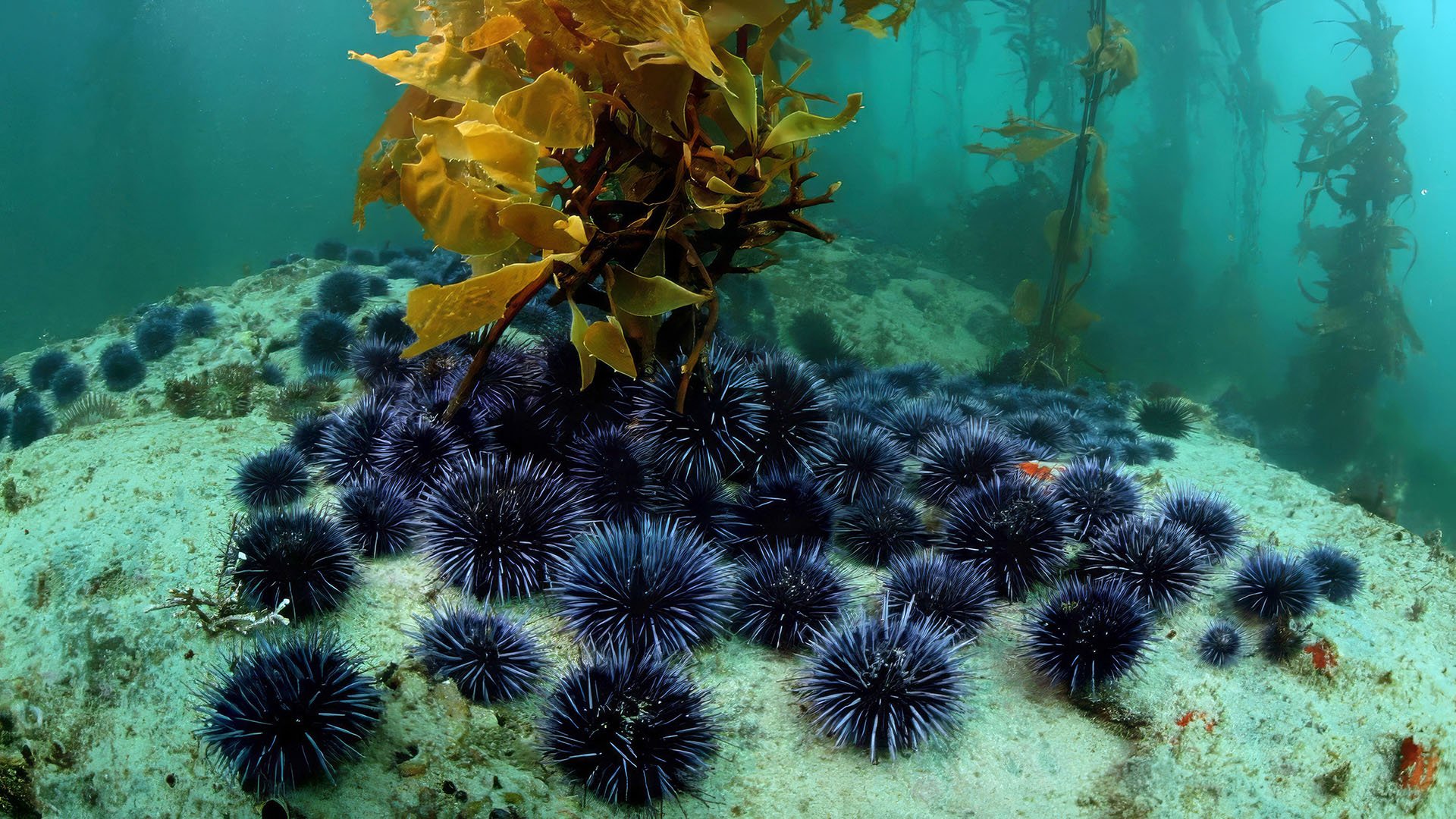
Urchin barren near Crook Point on the backside of San Miguel in California's Channel Islands. Photo credit: Jim Knowlton, Blue Ocean Productions.
Editor’s note: Bruce Steele is a Southern California urchin diver who has spent thousands of hours underwater observing patterns and anomalies in the California Current ecosystem. Here, he draws on that experience to describe in intimate detail what that underwater scene looks and feels like at the inception of what is predicted to be “perhaps the most fearsome El Niño since before scientists even began modeling them.” El Niños are a natural cyclical phenomenon caused by the periodic weakening of the tropical trade winds in the Pacific Ocean, but as global temperatures rise due to global warming, the ocean heat waves triggered by these cycles are becoming more extreme, temporarily halting the ocean upwelling that ordinarily delivers a smorgasbord of rich nutrients to this coastal ecosystem and resulting in dramatically changed ocean food webs.
By Bruce Steele
June 3, 2026—Typically spring brings offshore winds, northwesterlies, and upwelling of nutrients. February and March the winds start, spring comes early to California. April is usually very windy, the water cold, green, and full of jellies. Salmon water. But this year March was calm, kinda muggy, and much warmer than usual. The winds didn’t come.
Clear warm water is here, an ocean heatwave that presages a monster El Niño. The kelp beds are already weak and without the upwelled water, the kelp doesn’t get enough nutrients. The clear warm water is beautiful to dive in but as the Niño takes its grip, the life of the reef and the color of the sea life slowly fade white. Coraline algae come in beautiful pinks and violets, they normally cover the rocks and the calcium that makes up their skeletons provide food for invertebrate grazers like young abalone and sea urchins. As the summer proceeds the pink color of the reef will fade. The coralline algae will begin to die and without kelp or coralline the small invertebrates that depend on a typically bountiful vegetative diet begin to succumb. As the heat pushes the respiratory demands of reef life, the lack of nutrients slowly starves it.
Everything turns a ghostly white, the kelp gone except maybe some red kelps that somehow hang on but nowhere near enough to feed everything. Most small invertebrates succumb and the large abalone, turban snails, and sea urchins live off stored body reserves. Sea urchins can live a hundred years and they have lived through this before but they get weak and don’t spend energy on reproduction. For the large sessile invertebrates it is a waiting game and usually by next year the winds, upwelling and kelp return but sometimes like ‘82-’83, the damn thing stretches on into a second year and even the hardiest denizens of the reefs begin to fail. There are some urchins that benefit from the carnage because they are predatory, and meat eaters, and they move into shallow water where they don’t usually live. Other things like aggregating sea cucumbers increase in number too and get by on diatoms and detritus because there just isn’t much else there.
The abalone get so tired they begin to relax and you see the whole meat exposed as the shell rests on the sand. Abalone often live under ledges and the weight of their 7-8” shells and gravity results in abalone exposing themselves to predation. But for the most part the predators are gone too.
After months of starvation the El Niño winter arrives and with it huge storms driven farther South than most years. Swells can reach over twenty feet and the period can stretch to 22 seconds. It is hard to describe the havoc that results on the now weaker life on the reefs. Imagine if you will a river rapids, someplace where you know you’d die if you fell in. Now imagine being in that river but having the flow switch back and forth. Now imagine rocks, boulders the size of Volkswagens getting picked up and thrown. As one big rock breaks loose it crashes into the next and in some places fields of rocks, as wide as a freeway and stretching to the beach, are rearranged in a way where nothing living there survives. Nothing. Rubble.
Then one day after a couple years of heat the winds return, the water turns over again, gets colder, and life returns. The white reef gets to looking kinda dirty with a diatom cover. The diatoms grow something like brown grass and detritus settles into the diatom lawn. Then recruitment of giant kelp and Laminaria begins in the mud that settled into the fields of diatoms. The large invertebrates that survived begin a spawn period that gives them a jump on the now reduced number of small and micro predators that would normally feed on the newly recruited abalone or sea urchins. Getting a jump on recruitment predation only comes on the decadal or multi decadal timeframes of the Super El Niño recurrences. The reefs will regrow but not exactly like they were before the die-offs . Because some species get the jump on recruitment they can establish in areas where predation or micropredation formerly kept them in check. Kelp can reestablish where the purple urchins have disappeared, or disappeared long enough for kelp to establish strong footholds and resistance, at least temporarily, to the hordes of urchins.
We call it an alternate state ecosystem. It is disturbance driven, and we are midstream.
