
The USDA’s “Harvest Fuel Relief” program: What we know so far
By Sarah Schumann
October 21, 2026 — On October 19, the USDA announced a plan to issue $8 billion in one-time payments to American farmers this harvest season to provide relief during temporary market disruptions and increased input costs. This is the USDA’s third financial assistance package for farmers this year alone, but that is not remarkable. What is remarkable is one three-syllable word in paragraph 6: fishermen.
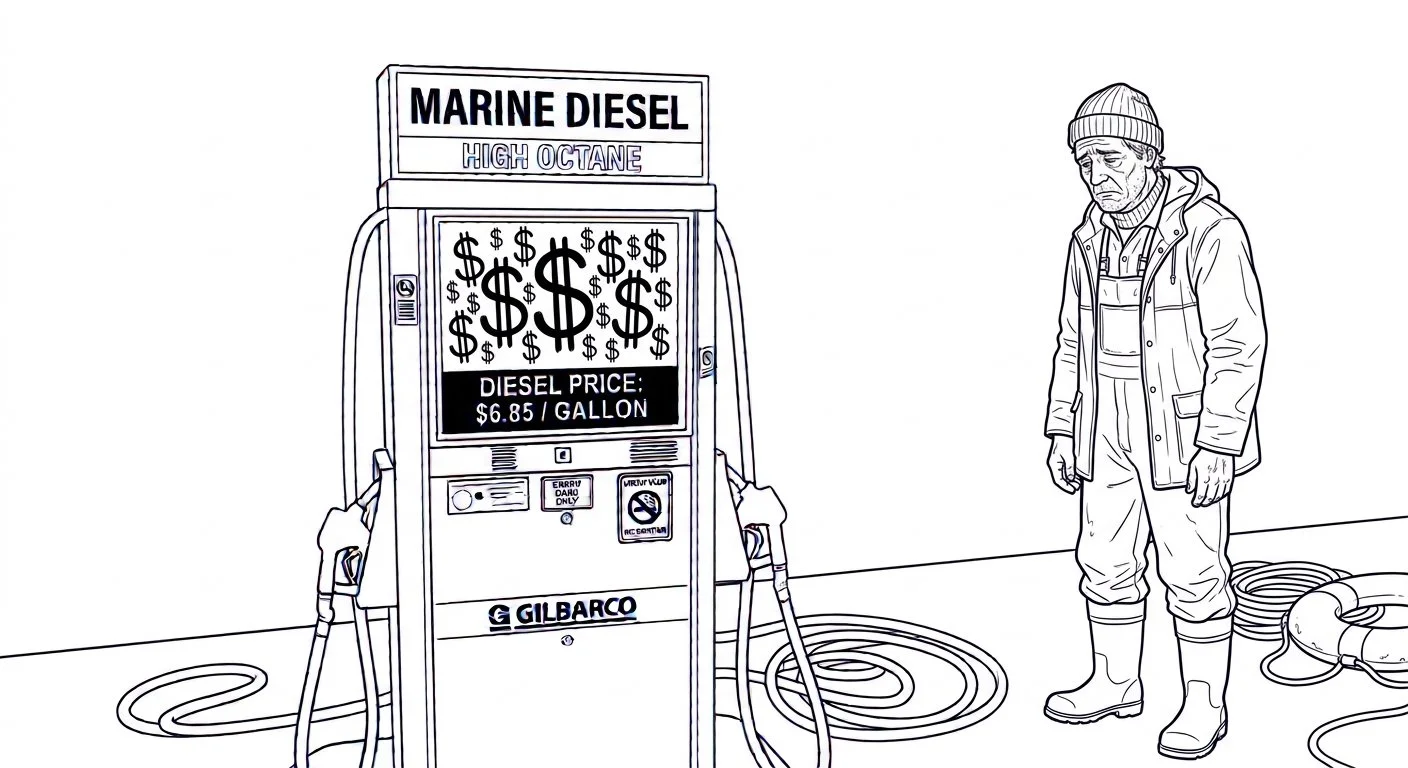
For fishermen and fisheries leaders who have been making the case for years that fishermen need the same kind of government supports and assurances as other food producers, the inclusion of fishermen in this relief program represents an exciting breakthrough. And it could not have come at a more necessary moment. The fishing industry has been buckling under the weight of record-high diesel prices for over half a year, and as an energy policy platform compiled by fishermen through the Fishery Friendly Climate Action Campaign earlier this year affirms, relief is sorely needed.
But how will payments to fishermen work in practice? When farmers receive aid like this, it’s based on long-established formulas that incorporate acreage planted and crops grown to spit out a dollar figure designed to offset each farmer’s overburdensome expenses. How is an agency that has a slim history of working with fishermen going to figure out how to fairly allocate funds to fishing businesses? How are fishing businesses going to confirm their eligibility or submit claims to receive assistance?
I reached out to the USDA’s Harvest Fuel Relief administrator to ask those questions, and this is what they said:
In order to determine appropriate and uniform payment rates for each sector of the industry, USDA is requesting additional data from fishermen and the seafood industry to better capture the impact of increased fuel prices on these operations.
Specifically, USDA is seeking data related to on-vessel fuel consumption, broken down by fuel used per hour, nautical mile, and/or per unit of catch. If available, please include information on the vessels used, average or range of catch size per trip. Pricing data may be submitted as well but is not required.
National data that is representative of entire industries is highly preferred.
While there is not a specific deadline for data to be submitted, USDA is moving quickly to ensure that this critical aid reaches producers as quickly as possible.
If questions regarding the data submitted arise, the USDA team may reach out for additional information. Please keep an eye on USDA’s official website and social media account for status updates regarding the HFR program.
Lastly, USDA staff stressed the fact that applications are not yet available for any commodity, including fishermen. USDA will publicly release more information on payment rates and the application process in the coming months.
Coordinating across the fishing industry to get this right
There have been several bottom-up efforts across the US fishing industry this year to collect anecdotal experiences and data points from fishermen and seafood business about how they are being impacted by the current fuel price crisis. I’ve been involved in several of those efforts myself, as this work overlaps closely with the Fishery Friendly Climate Action Campaign’s Transition to a Low Carbon Fishing Fleet workstream and supports the energy policy platform that was developed based on that work. Those efforts have, until now, been targeted at illustrating a need and persuading policy makers to do something about it.
Now that policy makers are acting on this need, the work will need to shift. Presenting the USDA with precise datasets from our respective fisheries that can be seamlessly compiled into a coherent prescription for action will be a big help to the agency staff while also ensuring the fishing industry gets what we need from this opportunity. We have leaders across the fishing industry who have done this kind of thing before (e.g, with tariff and Covid relief) and new leaders stepping up to the plate who could use some direction. How can we share knowledge across the industry and align around methodological approaches to gathering the requisite data? How can we coordinate around communications and be good partners to the USDA?
I don’t have the answers, but through the Fishery Friendly Climate Action Campaign, I can offer: a community list-serve for exchanging information among fishermen coast-to-coast; this blog for publishing thought pieces and updates publicly; and a Zoom account for hosting meetings so we can put our heads together and develop solutions. All three things are available to anyone from the fishing industry willing to show and share leadership on this issue. In the meantime, I will share out any further information I receive on our community list-serve. If you are a member of the fishing industry, please sign up for the list-serve here!
