
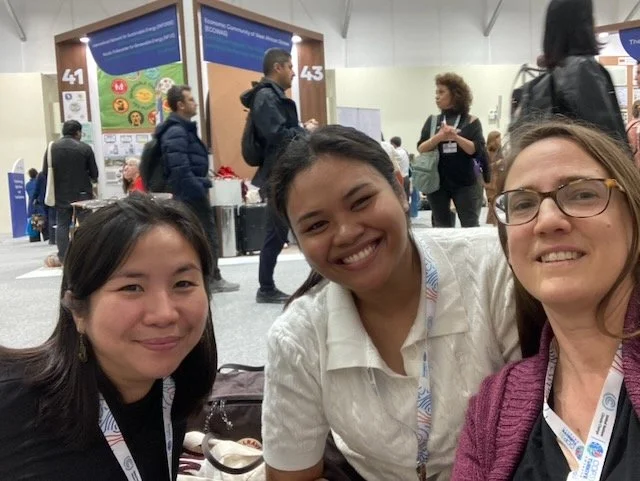
Faye Aldefolio, Mai Sriyanakarn, and Sarah Schumann at COP 31.
By Sarah Schumann
November 27, 2026 — I’ve always been curious about what happens at the UN’s annual climate conference. More specifically, I have wondered what role fishermen play — or could play — in these high-level negotiations and the global hoopla that surrounds them. This year, I traveled to Antalya, Türkiye, to find out for myself.
Fisher people’s representation at previous COPs
I know I’m not the first fisherman to attend a UN climate conference, more accurately known as a Conference of the Parties (COP) to the UN Framework Convention on Climate Change (UNFCCC). Alaska salmon set-netter Hannah Heimbuch attended COP 28 in Dubai, UAE in 2023. The World Forum of Fisher Peoples (WFFP) had a large presence at COP 30 in Belém, Brazil last year, where small-scale fishers from Brazil, Indonesia, Thailand, Sri Lanka, Ecuador, Kenya, and South Africa took part in a People’s Summit parallel to COP that “highlighted the need for a just energy transition, demanding an end to fossil fuel exploitation and the privatization of public services, while advocating for community-led solutions like agroecology and sustainable resource management.”
In fact, the WFFP group presented a report at last year’s COP, called Rising Tides, Shrinking Coasts, and Sinking Rights: Climate Crisis and the Struggles of Fisher Peoples. It detailed “the devastating effects of climate change on fisher livelihoods, including warming waters altering fish migration patterns, extreme weather disrupting fishing seasons, and ocean acidification harming marine ecosystems.” It also outlined “a visionary path forward: recognizing customary fishing rights, rejecting false solutions like carbon markets and exclusionary marine protected areas, promoting community-based resource management, and advancing gender justice within the sector.”
Watching the WFFP activities unfold on social media during last year’s COP, I felt those twinges of admiration/jealousy that one feels when they really want to be part of something cool but they’re not. Luckily, my work on marine carbon dioxide removal has put me in touch with people like oceanographer Kalina Grabb, who regularly attend COPs as part of their science work. So I asked Kalina for some tips.
The biggest thing I learned from Kalina is this: to attend a COP, you need a badge. It can take over a year to get accredited as a UN observer yourself, so it’s much faster to find an organization that is already accredited, and ask them if they have an extra badge to spare. I was incredibly lucky to find one, thanks to professors Alison Bates and Diana Elhard of Colby College, who set me up with a badge for Week 1 of the two-week COP. I owe them a huge debt of gratitude.
This year’s COP in Antalya was a little different from the COP last year in Belém. The civil society activities were more subdued than last year. To my dismay, there were no massive protests like the ones in Belém, which counted over 50,000 people among their ranks. Nonetheless, it was an eye-opening experience, and in the end, I did find my people at COP 31. But with an attendance tally of over 92,000 participants, it took some effort to find them!
Innovation on the Greek island of Amorgos
The first fisherman that I met was Michalis Krosman, who is president of the Professional Fishing Association of the Amorgos, Greece. Amorgos is a small island with a population of 2,000 in the Cyclades, with about 30 families who depend on fishing. I met Michalis when he spoke on a panel at the Greek delegation’s pavilion. On that panel, he showcased a system of area-based marine protection that he and his fellow fishermen set up about five years ago, after seeing their fish stocks decline and their local waters fill up with plastics pollution.
Under the Amorgos system, the fishermen’s group oversees a network of Fisheries Restricted Areas (FRAs), along with a broader framework of management, monitoring, and enforcement measures. They cease fishing altogether between April and May, which is a critical spawning period for key commercial species. During these months, they instead spend their time doing coastal clean-ups. When they start fishing again in June, they avoid the FRAs. They have also transitioned to more selective fishing gear, with larger hooks and larger mesh sizes in nets, in order to avoid catching juvenile fish.
None of this sounds easy, and Michalis and his fellow fisheries leaders in Amorgos must have some very good organizing skills. They achieved a well-earned milestone in August 2025, when the Greek government issued a presidential decree making their FRAs official and enforceable. When fishermen set things like this in motion, and the government follows their lead, it is truly an inspiration.
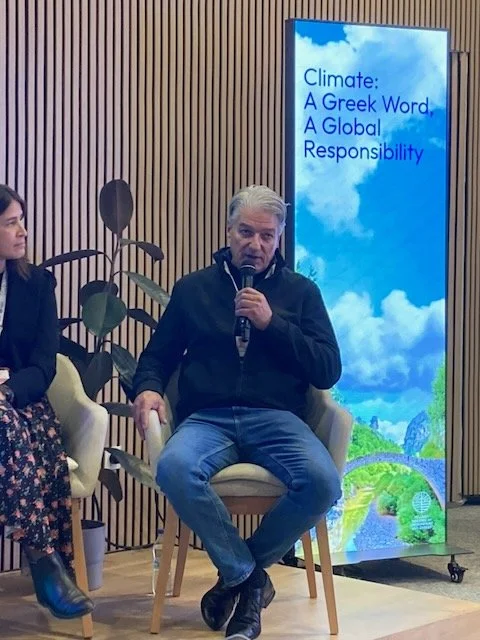
Fisherman Michalis Krosman speaks at the Greece Pavilion.
Women fisher folk from Thailand, the Philippines, and Bangladesh
The other fisher people I met were all women. All three also participate in the WFFP. I met them at the booth of the International Network for Economic, Social and Cultural Rights (ESCR-Net), which unites 300 social movements and human rights organizations and advocates across 80 countries, “collaborating toward the world we need: a world where care for people and the planet, solidarity, and equality inform decisions and shape structures to guarantee human rights for all.”
Faye Aldefolio (shown in photo at top and below) is involved with the PAMALAKAYA Pilipinas National Federation of Small-Scale Fisherfolk of the Philippines, an organization established in 1987 to unite and empower fisherfolk across the Philippines archipelago. The group’s 100,000+ members are dealing with the impacts of multiple forms of coastal development on local fisheries, including land reclamation projects, a proposed U.S. ammunition production and storage facility in a former naval base, and a set of U.S.-led economic and security projects under the Luzon Economic Corridor that threaten to displace small-scale fishermen and threaten their livelihoods.
PAMALAKAYA Pilipinas published this recap of their COP experience on Facebook. The WFFP also wrote about it, saying “Faye’s presence at COP31 highlights the importance of inclusive, rights-based approaches to ocean governance that center the people who have long stewarded the waters rather than treating them as obstacles to economic expansion.”
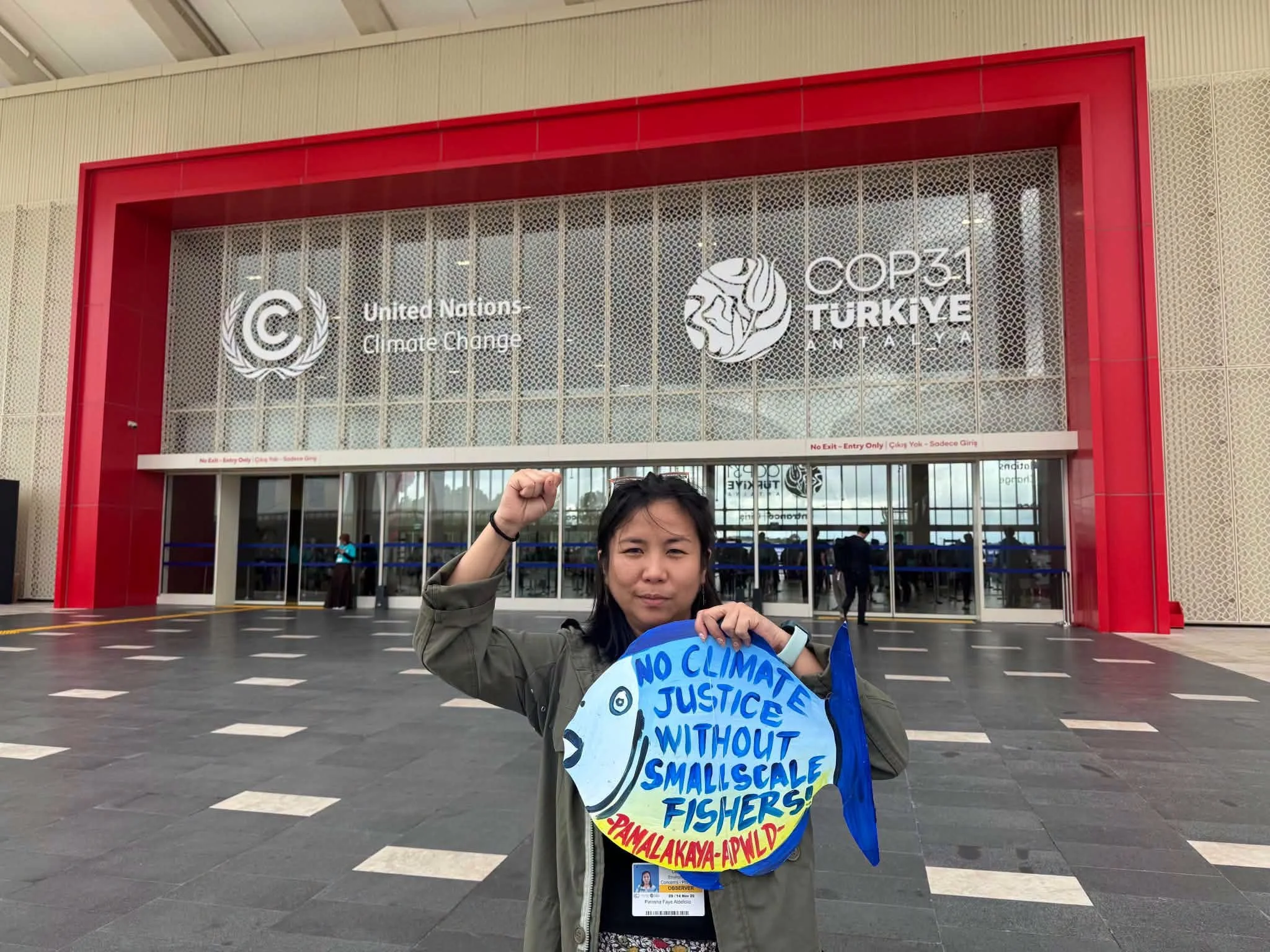
Faye Aldefolio holds up a fish-shaped placard reading "No climate justice without smallscale fishers" at COP 31. Photo courtesy of PAMALAKAYA-Pilipinas.
Mai Sriyanakarn (shown in photo at top) is with the Southern Fisherfolks Women Association (SFWA) in Thailand. While at COP, Mai participated in a the Global Day of Action for Climate Justice on November 14 to raise her voice against false solutions and climate resilient projects, representing the interests of grassroots coastal communities in southern Thailand. Here’s a video of Mai speaking about her COP experience at the Day of Action.
Lipi Rahman is the Executive Director of the Badabon Sangho, a women’s rights organization that works with women fisher folk communities in the mangrove-dense Southwest coastal region of Bangladesh. The group was founded in 2016 in response to a thermal power plant development. Climate change is now causing frequent cyclones and saline intrusion in their area, which causes skin diseases among the women who fish there. Facing a lack of political recognition and an inadequate social safety net, the women have started their own cooperative and a savings and loan program, organized rallies focused on gender equality, and formed a coalition of 15 fisher folk groups. As a result of their work, fisher women are now legally recognized by the government of Bangladesh, giving them access to the full spectrum of labor rights, protections, and entitlements.
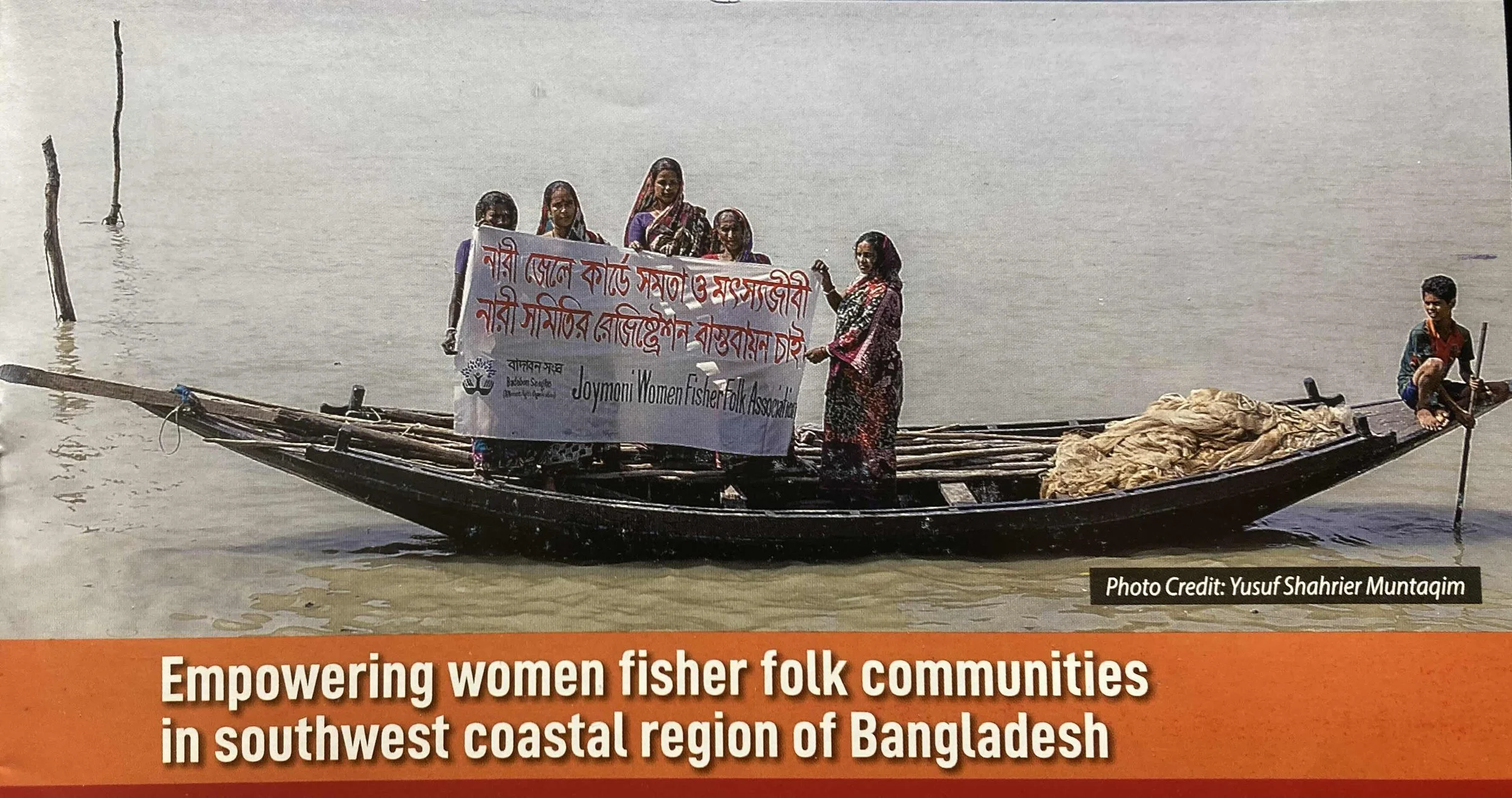
An image from a pamphlet published by Badabon Sangho, titled “Empowering women fisher folk communities in southwest coastal region of Bangladesh.”
African fisherwomen
I was only at COP 31 for Week1 , but I continued tracking COP news during Week 2 from afar, and that’s how I found out that members of the African Women Fish Processors and Traders Network (AWFishNET) were on the ground there after I’d left. This group serves as a hub for sharing best practices, exchanging experiences, and embracing innovative technologies while fostering collective learning. Founded in 2017, AWFishNET now boasts 44 member countries across the African continent.
Upon arriving at COP 31, the group posted:
Across Africa, women fish processors and traders are on the front line of a changing climate. They see shifting fish stocks, degraded coastal ecosystems, and growing pressure on the shores, lakes, and rivers they depend on. They also hold practical, community-rooted knowledge of how to adapt. Yet their voices are too often missing from the rooms where climate decisions are made… Climate action that begins from the ground up has to begin with the people on the ground. We look forward to standing alongside fellow movements and partners to make that case.
During COP, AWFishNET’s president Lovin Kobusingye spoke at a side event called “From the Ground Up: Accompanying Territorial Movements for Oceans, Forests, and Energy,” at an event at the Africa Pavilion called “Africa’s Blue Economy in Action: From Continental Ambition to Country Implementation,” and at an “interactive fishbowl dialogue” at the Food & Agriculture Pavilion titled “Blue Transformation in Action: Scaling Climate-Resilient Aquatic Food Systems Across Africa.” Members also connected with negotiators, governments, researchers and partners, advocated for aquatic food systems to be included in national climate action, and pushed for inclusive trade, financing and investment that reaches small-scale women processors and traders.
In a video reel on Facebook, Oluwafunmilola Shelika, AWFishNET’s president for Nigeria, said:
The biggest problem we have now is that in number of policies, women have just been recognized. We need action. [Women] need access to those fundings to be able to scale the solutions that women have already come up with concerning the ocean. Because their livelihoods depend on the ocean…. With this in mind, we are calling that women should have access to those kinds of climate fundings that have been negotiated and been set aside… It should be community-led for them, so that they can really benefit from what is out there.”
AWFishNET may have a particularly important role to play in next year’s COP 32, which will be held in Addis Ababa, Ethiopia. They posted:
We see this as a special moment. Global climate conversations will take place on African soil as we mark a decade of AWFISHNET as a network. This is a chance to ensure the voices, knowledge, and realities of women in African fisheries are seen and heard where decisions are made.
I very much look forward to their success — and maybe, if I can snag a badge again, to meeting them in Addis Ababa.
What about me?
I’m also a fisherman, and being based in the U.S., I represent a fourth continent in the panorama of COP 31 fisheries participation showcased in this blog. Unfortunately the U.S. is no longer a party to the UNFCCC, so I didn’t have any direct avenues to provide input to the decisions being made. Instead, my COP participation was focused on interacting with other members of civil society and trying to understand where oceans fit into the negotiations. I spoke on a panel in the Ocean Pavilion called “From Coastal Communities to Global Cooperation: Shaping Responsible Marine Carbon Dioxide Removal” and organized — with Kalina Grabb — a workshop called “Designing Ocean-Friendly Climate Mitigation Portfolios.” I hung out with the official COP farmers constituency and participated in a daily “ocean huddle.” I’ve save more details on these things for future blog posts!
Conclusion
Although I did many things during my week at COP 31, the best part of COP for me was meeting my fellow fishermen. Whether we hail from the U.S. or Africa, Bangladesh or Greece, Thailand or the Philippines, there are so many things we have in common.
For one, we’re all experiencing the effects of climate change and other forms of pollution. Whether that manifests as shifting fish stocks, marine plastics debris, ocean acidification, or saltwater intrusion, it’s upending our confidence in the future and in some cases having real-time impacts on our ability to make a living and sustain our families and communities.
Second, for fishermen across the world, those climate impacts cannot be easily extricated from other pressures. In the U.S., offshore renewable energy development and marine carbon dioxide removal (mCDR) research projects have shown that sometimes the solutions to climate change can be just as scary, at the local level, as climate change itself. In the Philippines, fishermen risk being displaced by the imperialist and militaristic ambitions of the very government that my fellow U.S. citizens elected. In Bangladesh, the work of Badabon Sangho demonstrates the ways that climate stressors are magnified by poverty and gender discrimination.
But the most important thing we all have in common is this: we’re all doing something about it. The fishermen of Amorgos implemented a self-organized system of marine protection that was eventually recognized by the Greek government. The fisherwomen of Africa have organized a grassroots network that is 44 countries strong. Fisherwomen in Bangladesh have changed national policy to secure legal recognition for their trade. And of course, we all made the time to cross oceans and airspaces to participate in the 31st Conference of the Parties to the UN Framework Convention on Climate Change.
I hope that my fellow fishermen had a productive COP experience and that the good work they are doing in their home countries continues to bear fruit. As the COP’s well-publicized failure to come an international political agreement this year demonstrates, high-level dialogues can be susceptible to gridlock. In contrast, the fishermen who showed up at COP 31 show that at the grassroots level, organizing to make the world a better place is happening everywhere — and that’s something to celebrate.
