
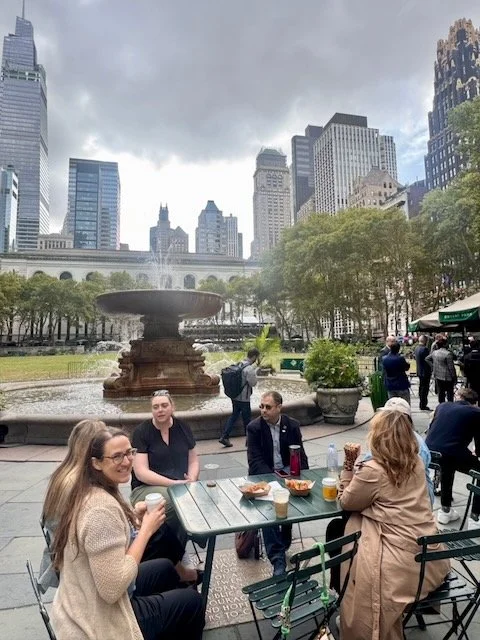
A fishermen-organized “mug-up” in Bryant Park. Photo by Kinsey Brown.
By Sarah Schumann
November 5, 2026 — Commercial fishermen are directly affected both by climate change itself and by many of the solutions proposed or implemented to combat the climate crisis. Yet they have long been absent from society’s climate conversations. Luckily, that is beginning to change, and there is no better proof of this shift than this year’s Climate Week NYC.
Climate Week is a decentralized climate conference held at hundreds of venues across New York City annually during the third week of September. With over 1,500 self-organized events, it is the largest climate event globally, drawing over 120,000 people to the city to learn and talk about climate change and its solutions.
This year, over a dozen commercial fishermen and small-scale aquaculture producers were part of that throng. Their participation represents an important early step towards greater recognition of the fishing community as a climate-impacted constituency and greater inclusion of this constituency in the climate dialogue.
Better Values, Better Seafood
The North American Marine Alliance (NAMA) and Resource Media brought a dozen fishermen, Indigenous fisheries leaders, and small-scale aquaculture producers to lead an event titled “Who Decides the Future of Seafood?” The event coincided with the launch of their Better Values, Better Seafood Campaign, which features fishermen leading from the heart and helps the public “enjoy flavorful moments seasoned by the lives and living places that keep seafood fresh.”
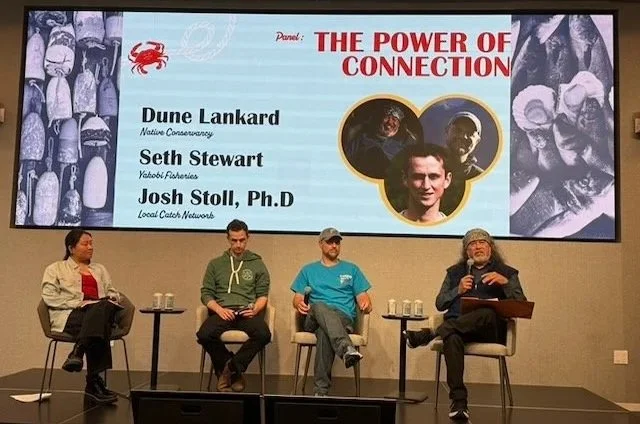
feini yin (NAMA) moderates a panel with Josh Stoll (Local Catch Network), Seth Stewart (Yakobi Fisheries), and Dune Lankard (Native Conservancy)
A series of panels during the event focused on the following themes:
The return on our values, featuring Jason Jarvis (Rhode Island fisherman, Quonnie Fish Company), Anna Stewart (Yakobi Fisheries), and Captain Charlie Abner (Georgia/South Carolina fisherman/shrimper; Capt. Charlie's Fish Company)
The power of connection (photo above), featuring Josh Stoll (Maine aquafarmer, Local Catch Network), Seth Stewart (Yakobi Fisheries), and Dune Lankard (Native Conservancy)
The fight for our future (photo below), featuring Tela Troge (New York aquafarmer, Shinnecock Kelp Farmers), Sarah Schumann (Rhode Island/Alaska fisherman, Fishery Friendly Climate Action Campaign), and Justin Solet (Louisiana shrimper, Louisiana Liberation and Sovereignty Collective)
Panels were interspersed with plenary presentations by Bette Billiot (Louisiana shrimper, Louisiana Liberation and Sovereignty Collective), Brett Tolley (Massachusetts fisherman, Chatham Harvesters Cooperative), Melanie Brown (Alaska fisherman; SalmonState, World Forum of Fisher People), and Jennifer Jacquet (Rosenstiel School of Marine, Atmospheric, and Earth Science at the University of Miami).
Speakers and audience participants then got better acquainted during a reception, and took in gorgeous views of the city below.
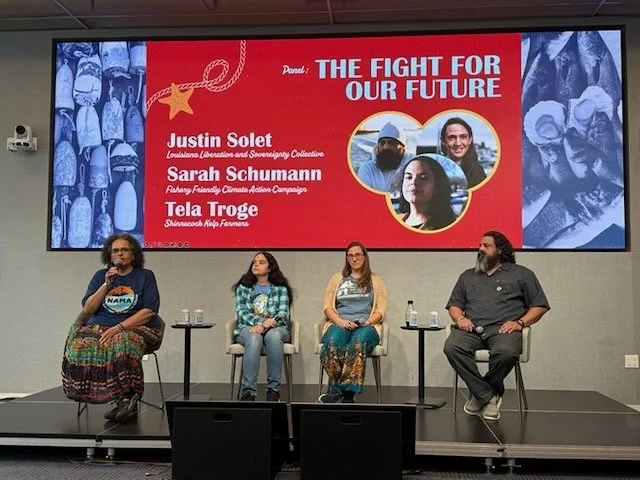
Niaz Dorry (NAMA) moderates a panel with Tela Troge (Shinnecock Kelp Farmers), Sarah Schumann (Fishery Friendly Climate Action Campaign), and Justin Solet (Louisiana Liberation and Sovereignty Collective).
Here’s what some of the fisherman who participated in this event had to say:
"Fisher people have a first hand view of what is happening in the environment every day that they are out doing their work to feed the world. They possess a complete way of observing changes around them and these ways of knowing should be more highly valued." — Melanie Brown, Bristol Bay set-netter and salmon advocate at SalmonState [Juneau and Naknek, Alaska]
“I feel that many attendees had never spoken with or had a glimpse into our world. The stigma and preconceived beliefs around fishing have obscured the truth about who we are and what we do. Many conversations at the reception were focused on wanting to know more about who we are and what we do.” — Jason Jarvis, fisherman and North American Marine Alliance board member [Westerly, Rhode Island]
“Many people don't see the people behind the scenes, which is what we were able to present with our talk at NYC Climate Week. We shared the story behind the ‘local’ seafood idea and what people support when they choose to eat local: small communities and sustainability.” — Anna Stewart, Yakobi Fisheries [Pelican, Alaska]
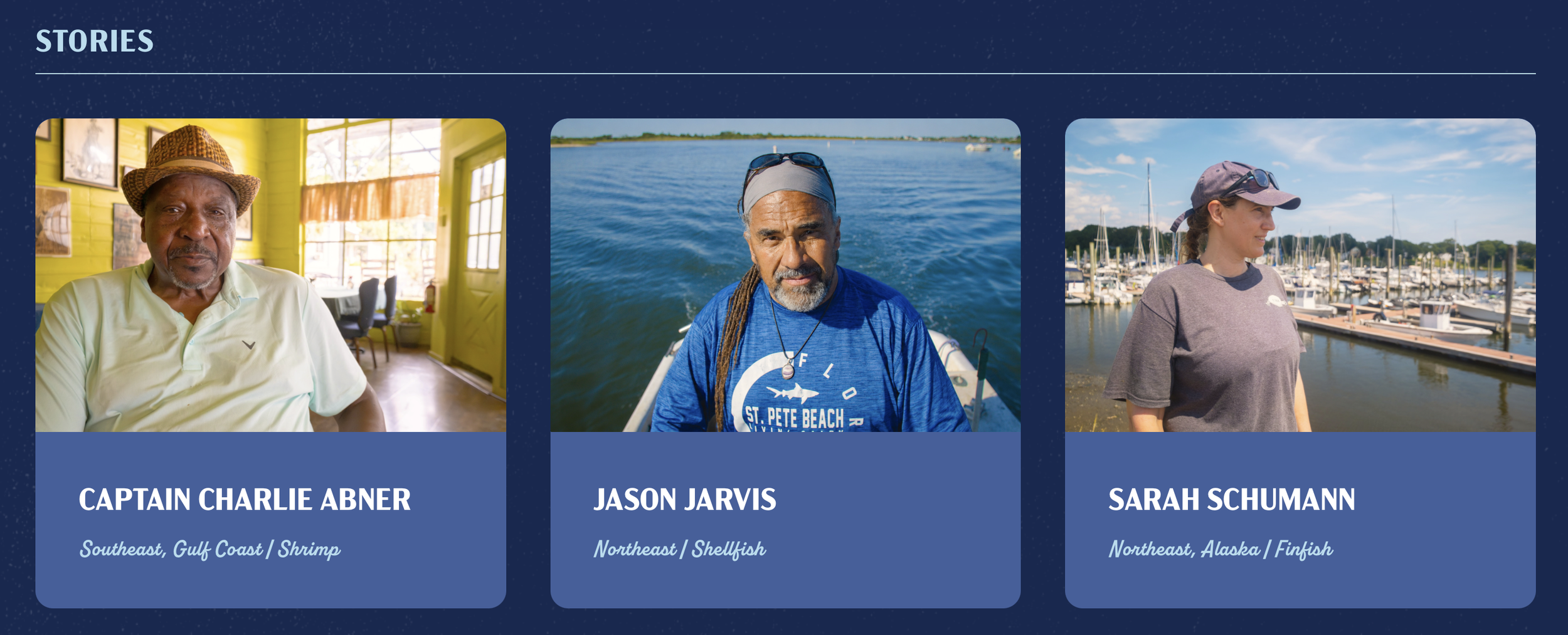
Click here to watch short videos by Resource Media featuring these three fishermen!
Alaskans represent their fisheries at mCDR events
Kinsey Brown and Danielle Ringer fish in Cordova and Kodiak, Alaska, respectively. Both are also social scientists and members of the Alaska Dialogue on mCDR (mCDR is short for marine carbon dioxide removal).
Kinsey spoke at an event titled, “Speed of Trust: How to Act Fast on Climate Without Leaving Communities or Ecosystems Behind.” Hosted by Carbon 180, the event featured coastal community leaders from Alaska, Hawaiʻi, and Puerto Rico. Discussions centered around defining community, building community capacity, and creating the conditions for communities to lead.
Kinsey took away the following thoughts from her NYC Climate Week experience:
“At NYCW it was clear that there's a lot of excitement around carbon removal and what new technologies might make possible. But from a fishing community's perspective, the question isn't just whether something works in a scientific sense, but rather what happens in the places where that research takes place, who carries the risk, and who benefits. I think for companies and research groups who want to pursue mCDR in coastal communities, building trust means showing up, being transparent about uncertainty, listening to people who make their living on the water, and recognizing that meaningful engagement takes time.”
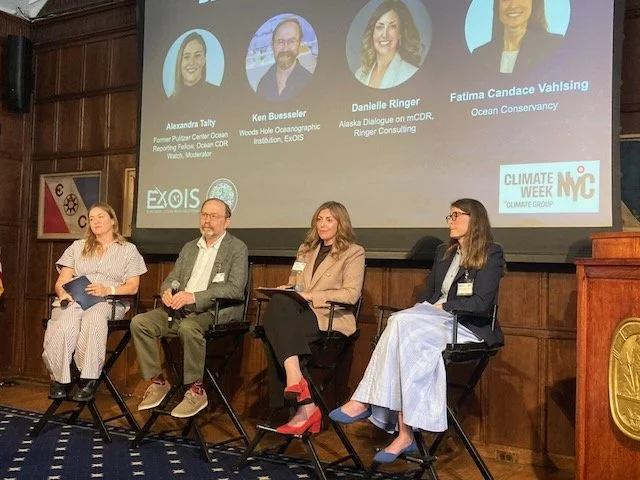
Danielle Ringer (third from left) speaks at “Bending the Climate Curve.”
Danielle spoke at an event called “Bending the Climate Curve,” hosted by the Exploring Ocean Iron Solutions (ExOIS) consortium (photo above). The panel explored the state of emerging methods to enhance the ocean’s natural carbon sink, in particular phytoplankton-based approaches, and discussed how diverse approaches can inform responsible innovation and implementation, as well as the guardrails needed to guide field trials and future action while safeguarding the ocean.
Reflecting on her Climate Week NYC experience, Danielle said:
“At the 2026 New York Climate Week, it became clear to me that often well-intended climate policy is being shaped in rooms where the people who live and work on the water are rarely at the table. Scientists, funders, and decision-makers seem acutely interested in American working waterfront community engagement, and that’s a great start! Fishermen have a lot on their plates, and yet it is critical to continue showing to speak about questions, concerns, and ideas they have when it comes to ensuring emerging ocean activities are fishery friendly.”
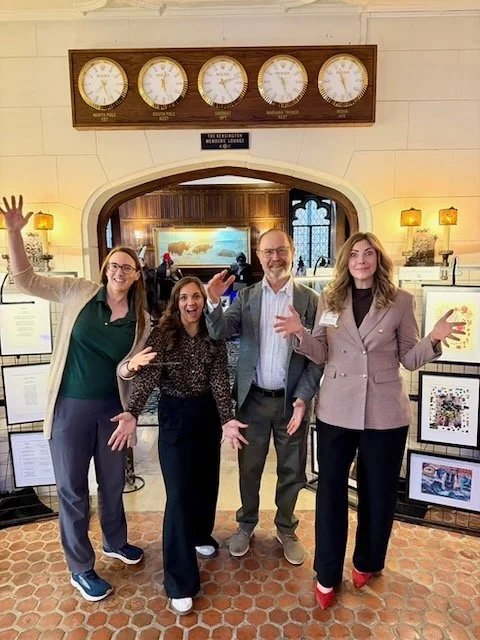
Fishermen Sarah Schumann, Kinsey Brown, and Danielle Ringer pose with Ken Buesseler (third from left) of the ExOIS research consortium at the Explorers Club in New York City. Photo by Katie Roche.
Conclusion
A central principle of the Fishery Friendly Climate Action Campaign’s work is that fishermen and coastal leaders must be squarely included in the dialogue on climate change and climate solutions. This means that climate leaders must make space to include fishermen, and fishermen must make the time to show up. At Climate Week NYC, both of these things fell into place. Thank you to the Northwest Atlantic Marine Alliance, Resource Media, Carbon 180, and the ExOIS consortium for making space to platform fishermen. And thank you to Jason Jarvis, Melanie Brown, Anna Stewart, Seth Stewart, Captain Charlie Abner, Justin Solet, Tela Troge, Josh Stoll, Bette Billiot, Brett Tolley, Dune Lankard, Danielle Ringer, and Kinsey Brown for showing up to represent the fishing community!
Thank you also to the GRACE Communications Foundation, whose generous funding enabled me to stay in Manhattan for the entire week, soaking up policy panels, receptions, and book talks to my heart’s delight. Climate Week NYC was a wonderful immersion in the climate space and I look forward to returning year after year.
