
Fuel prices are hurting the fleet. It’s time to take action.
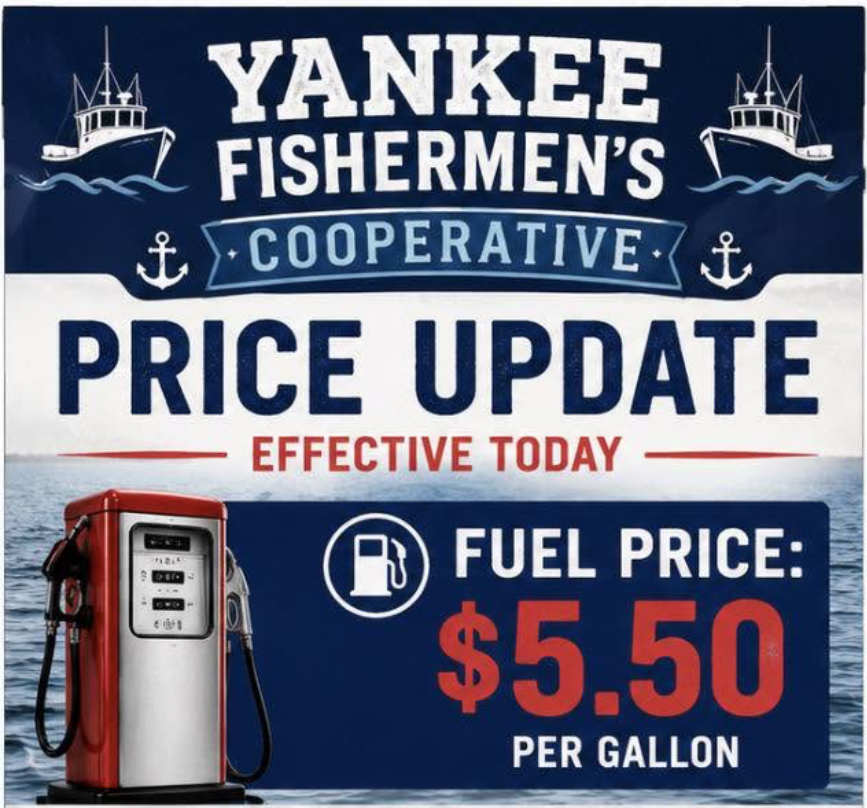
Diesel fuel prices advertised by the Yankee Fishermen’s Cooperative in Seabrook, New Hampshire on June 4.
By Sarah Schumann
June 5, 2026—In fishing ports worldwide, fishermen are feeling the pinch. Fuel that cost $3.75 a gallon a year ago in Kodiak now costs $6.70. In New England, fishermen are paying $5.80 a gallon at the fuel dock, up almost $2.00 compared to last year. Across the country, the story is the same. “The impact it’s going to have on our commercial fishing guys this summer, I can’t even imagine,” said a Plymouth, Massachusetts fisherman interviewed by a local radio station.
Although the cost of the diesel in fishermen’s fuel tanks is the most obvious expense, fuel costs affect virtually every part of the fishery supply chain. Fuel surcharges are showing up in the cost of lobster trap wire and bait, according to lobstermen in Provincetown, Massachusetts and Point Judith, Rhode Island. Fisherman who ship their product to Washington from Alaska for processing, storage, and distribution are grappling with shipping surcharges as high as 18.5%—double what they were being charged a year ago, said Dan Tucker of the Working Waterfront Coalition of Whatcom County.
Moreover, seafood processors and distributors, who are burdened by high fuel and energy costs of their own, often adapt to these increased input costs by paying fishermen less for their catch.
“Processor fuel costs affect the price they pay us per pound,” said Bristol Bay fisherman Antonio Arena. “The lost revenue from a decrease in price per pound for many operations exceeds the loss suffered by our own expenses. This is all to say, the fuel we burn (again from a purely economic view) is an expense, but the indirect cost I feel significantly outweighs the price per gallon we pay at the fuel dock.”
Some in the industry are sharing stories of fellow fishermen who are cutting seasons short, limiting their scope and range, or are simply skipping openings altogether this year, according to Tucker. "It's the cost at the pump to fuel the boat, the cost of services if things break or need repair as businesses increase charges to cover their own fuel costs, crews paying higher costs in travel to and from Alaska, and a host of other indirect cost increases stemming from fuel prices in every sector of labor involved in fisheries.
“Operating costs were already high. Now they are brutal,” concurred Linda Behnken, who fishes in Sitka, Alaska and leads the Alaska Longline Fishermen’s Association. However, Behnken and her collaborators also have reason to celebrate: this spring, they launched the refurbished F/V Mirage, a Sitka-based longliner/troller owned by fisherman Jeff Turner. With newly added hybrid-electric capabilities, the Mirage can operate either on a diesel engine or on a set of two electric motors.
“The bright spot for us has been the success of our hybrid boat,” Behnken said. “We’re just getting to work now on the second. There is also work happening on a Bristol Bay parallel hybrid— also a great project!”
What are the solutions?
Widespread adoption of technologies like the F/V Mirage’s hybrid system is a long way off for most fishing boats. That technology is in the pilot stage, and the costs are prohibitive without grant money. But as research published last year through the Fishery Friendly Climate Action Campaign made clear, myriad low-hanging fruit solutions are available in fishing ports today to help vessels save fuel without imposing new risks.
This category of solutions include things as basic as the application of high-tech bottom paint, or even just making sure that every boat gets regular haul-outs to remove fouling from its hull (a step that operators sometimes skip when their fisheries experience downturns in revenue). It includes installation of more efficient propellers, or simply hiring propeller technicians to evaluate whether a boat’s propeller is properly tuned and optimized for its hull and engine. It could include installing fuel flow meters on older engines that aren’t equipped with dashboard fuel-burn read-outs, giving captains real-time information so they can adapt their speed to save fuel. For trawl fishermen, who cannot adjust their speed or towing power without sacrificing performance and catch, there is a plethora of fuel-saving options focused around the gear itself: lighter towing cables, lighter twine, knotless twine, high-profile trawl doors, net and door sensors that tell the captain when the net is full, and sonar tech that helps captains better locate fish so that they can reduce the time they spend towing an empty net in search of schools.
A second category of solutions includes alternative fuels. While hydrogen, ammonia, and methanol are a long ways away from being available and applicable on fishing vessels, biodiesel and renewable diesel are already available in some ports, and they are readily substitutable for petroleum-based diesel. What’s more, they require minimal engine room modifications to be usable.
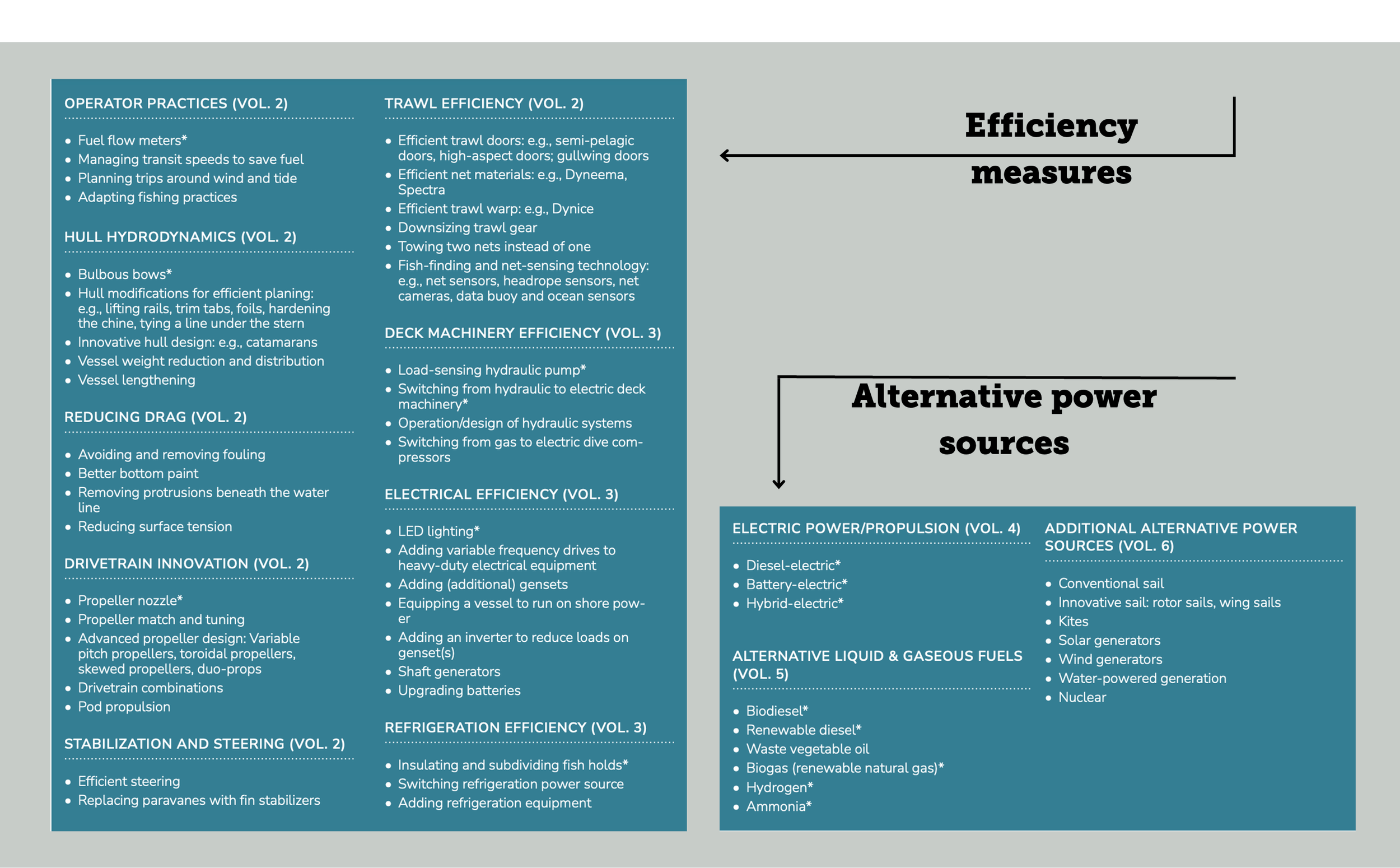
The Fishery Friendly Climate Action Campaign’s “Transition to a Low Carbon Fishing Fleet” research crowd-sourced a list of efficiency measures and alternative power/propulsion sources from the fishing fleet across Alaska, the West Coast, and New England.
The need for public supports
However, although these fuel-saving solutions are available, adoption rates are slow. The barriers most frequently cited by fishermen participating in the Fishery Friendly Climate Action Campaign’s research are (1) a lack of knowledge about which solutions are applicable to which kinds of vessels and how much fuel they can save, and (2) the financial costs of adopting these solutions.
That’s where targeted public funding can come in. As detailed in the volume titled, “Fishermen’s Recommendations for New Programs and Policies,” an influx of state and federal dollars could unlock:
New and improved incentive programs to encourage cost-effective adoption of currently available technologies;
Knowledge transfer and workforce development programs to help fishermen and their marine service providers understand what energy-saving solutions will work and how to install/maintain them; and
Over the long run, pilot and demonstration projects like the F/V Mirage to generate empirical data and trust in solutions that haven’t yet been proven in action.
But none of these moves, on their own, will help fishing operations simply survive the 2026 fishing season—especially when high oil prices are not only making it more expensive to fill up the fuel tank, but are also driving parallel increases in other input costs (e.g., bait and gear), shipping costs, and labor costs, along with a possible decline in ex-vessel prices offered by some seafood buyers. There’s only one way fill that gap: direct assistance.
A problem that’s not going away
Fishermen who have been working on the water for at least two decades are experiencing the third diesel fuel price crisis of their careers (see graph below). With each successive crisis, it becomes more obvious that action is needed.
During the 2008 price spike (caused by surging global demand, stagnating production, a weakening U.S. dollar, and heavy financial speculation), some fishermen autonomously adapted their fishing boats to run on waste vegetable oil collected from local restaurants—a history that is detailed in the Fishery Friendly Climate Action Campaign’s research on “Alternative Liquid and Gaseous Fuels.”
During the 2022 price spike (caused by Russia’s invasion of Ukraine), fishermen’s talk on the dock led to the launch of the Fishery Friendly Climate Action Campaign’s “Transition to a Low Carbon Fishing Fleet” research project, which interviewed 148 fishermen, 16 technical assistance providers, and 11 port managers about a variety of different technology and policy pathways to using less petroleum-based fuel—all with the purpose of supporting fishermen-led advocacy for public policy solutions.
The current prices spike (caused by Iran’s closure of the Strait of Hormuz in response to U.S.-Israel attacks), is just getting started, according to experts. But it’s already causing pain and anxiety across U.S. fishing ports.
Now is the ideal time to dust off the “Transition to a Low Carbon Fishing Fleet” work, package it in a format tailored to the political realities of 2026, and set in motion the fishermen-led advocacy that this work was originally designed to unleash. The Fishery Friendly Climate Action Campaign—a fishermen-led infrastructure of relationships designed to unlock grassroots momentum towards fishery-friendly climate solutions—is ready to get the ball rolling. If you’re a member of the U.S. commercial fishing industry, you can join this team effort by signing up for our community list-serve.
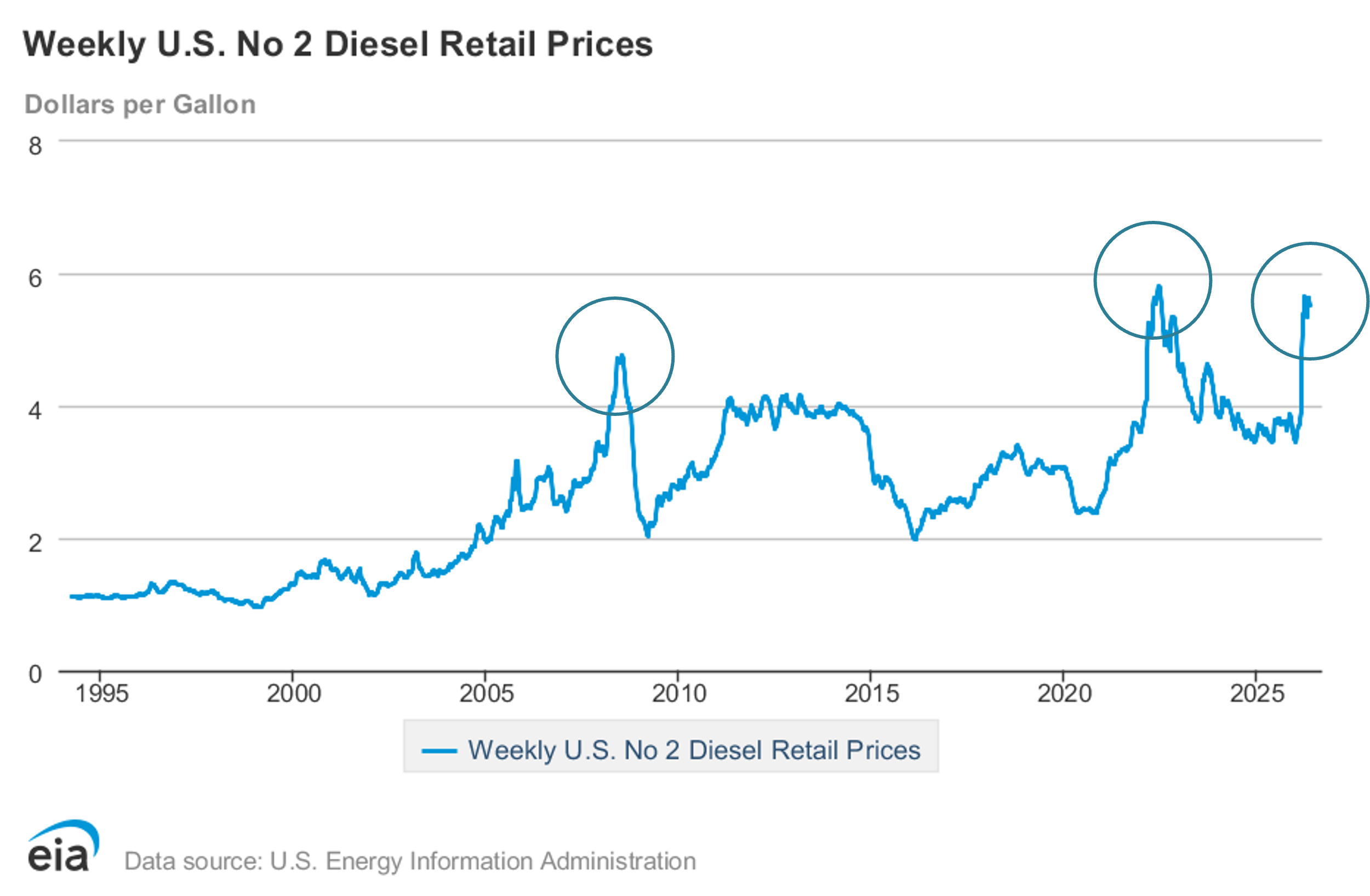
Prices of on-highway diesel, 1994-2026 (off-road diesel data is not available, but the price of off-road diesel is the price of on-road diesel minus the fuel tax). Source: Energy Information Administration.
News from around the web
Local news outlets around the world have been reporting on the fishery impacts of skyrocketing fuel costs since early April. Here is a sample of U.S.-based news. We will continue to update this list as new stories come out.
National (April 1): Fuel costs squeeze US fleets as Dungie season ends on a low note
Rhode Island (April 2): Rhode Island's fishing industry is feeling the pinch of high fuel prices
California (April 2): Skyrocketing diesel costs impact fishing industry on the Central Coast
Hawaii (April 2): ‘Really challenging’: Fuel surge hits Hawaii drivers, fishing industry
Maine (April 5): Running on empty
National (May 1): Fishermen weigh fuel costs against the catch
Rhode Island (May 11): Fishermen struggle with higher fuel costs as Iran war continues
Pacific Northwest (May 15): Rising fuel costs ripple through Northwest’s fishing industry
New Bedford (May 18): New Bedford fishing industry sees impact of rising fuel costs
Pacific Northwest (May 18): Rising diesel prices squeeze Oregon and Washington fishermen
Massachusetts (May 18): Local Fishermen Feeling Impact Of Higher Fuel Prices
Maine (June 1): High diesel prices may dampen summer lobster fishing season
Kodiak (June 4): High fuel prices could hurt Kodiak’s salmon fishermen
