
Ten takeaways about marine carbon dioxide removal from the Ocean Sciences Meeting
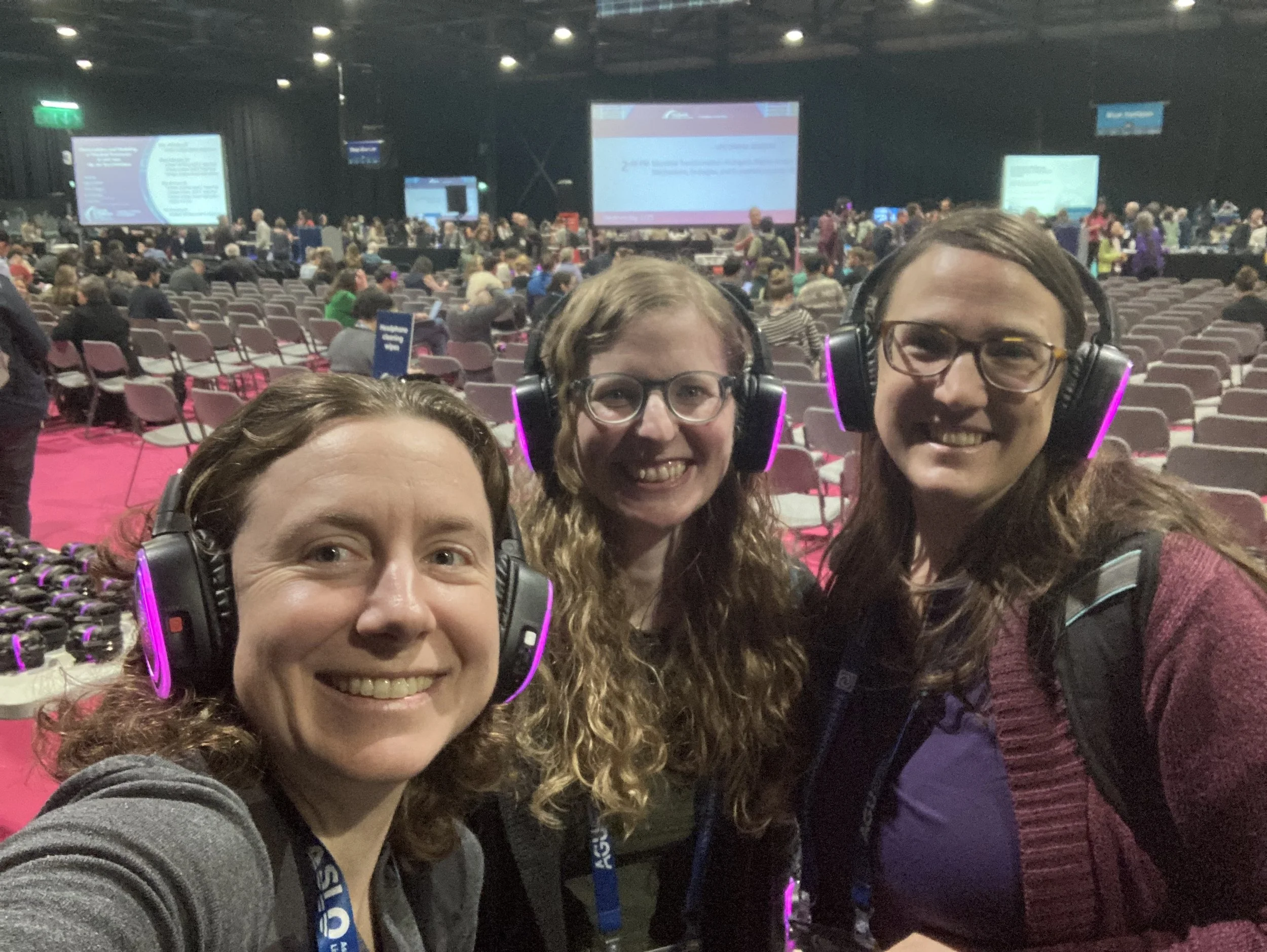
From left to right: Darcy Dugan, Caitlin McKinstry, and Sarah Schumann pose in the Ocean Sciences Meeting’s vast oral presentation room, where attendees used headphones to select a talk of their choosing. The novel format created a “silent disco” effect that added a layer of humorous charm to the scientific event.
By Darcy Dugan and Sarah Schumann
At the end of February, the two of us made a trip to Glasgow, Scotland to attend the Ocean Sciences Meeting. This event, which happens every two years, bills itself as “the flagship conference for the ocean sciences and the larger ocean-connected community.”
The conference’s offerings included every oceanography-related topic imaginable, but we were there with a focus: to learn everything we could about marine carbon dioxide removal (mCDR) and share what we learned with our networks back home. For Darcy, who is the director of the Alaska Ocean Acidification Network, that network includes her home state of Alaska and a small group in the Gulf of Alaska who started a project called the Community Leaders and mCDR (CLaM). For Sarah, who is the director of the Fishery Friendly Climate Action Campaign, that network includes commercial fishermen and fisheries organizations from Alaska, the West Coast, and New England.
The first thing we observed, as we pushed through the crowd to retrieve our name badges, was the number of people there. This was a huge conference, with over 6,000 scientists congregating from around the world. In fact, it was big enough to have its own mascot: a tartan-wearing Highland cow named Clyde (for the river that runs through Glasgow). Plush versions of Clyde were available for purchase at kiosks throughout the event campus for those wanting to take home a souvenir. His tartan was specially designed for the event and registered with the Scottish Register of Tartans, representing the blues and greens of the ocean.
The next thing we noticed was how prominently mCDR featured in the conference line-up. Across the five-day the conference program, we counted 11 mCDR-focused oral presentation sessions featuring a total of 78 talks and three mCDR-focused poster sessions featuring a total of 84 posters, as well as two mCDR town hall events, at least three offsite mCDR side events, and one mCDR happy hour. There were enough mCDR-related events that an attendee could just about jump from one to another for five straight days without a break.
We asked some scientists who had attended previous Ocean Science Meetings whether mCDR had been as ubiquitous in years past. They said no, that this was a new phenomenon. This led us to draw our first two conclusions from the event. Takeaway #1: mCDR is big. Takeaway #2: It’s gotten big fast.
The other important lessons took longer to emerge. As we sat through town hall conversations and talks with titles like “Simulated scenarios of pulsed ocean alkalinity enhancement in an oligotrophic region and potential responses in geochemistry and plankton dynamics” and “In-situ assessment of the fate of sunken biomass in the deep ocean: insights into biogeochemical cycling, carbon sequestration potential, and benthic ecosystem alteration,” additional themes began to sink in.
Takeaway #3: Like many in the fishing community, the science community is curious, concerned, and skeptical about mCDR. They are interested in the possibilities, but are not yet convinced that the mCDR approaches will work. They are also worried about scale, and are not sure if projects can scale effectively or safely. For these reasons, they are interested in using sound science to find out (1) whether any of the mCDR approaches work and (2) if they are safe. The scientists we heard from at the Ocean Sciences Meeting are not techno-optimists trying to push this field.
Takeaway #4: There is a shared understanding that there are certain things we will only learn through field trials. There is a strong interest in siting field trials in places and at sizes where the risk of environmental impact is very low. When conducting early field trials, scientists feel they need to oversample the system for a while to find out what is more important for required monitoring once mCDR becomes routine.
Takeaway #5: Scientists are invested in better understanding the environmental impacts of mCDR. Although ecological impacts studies lag behind studies on the efficacy of mCDR, they are starting to catch up. There is support for stage gating, or identifying what criteria would allow or prevent an mCDR project or method from moving on to the next phase of research or scaling, and if mCDR trials show that mCDR is not environmentally safe, researchers want there to be a “rigorous offramp” (verbatim from a presentation) in place to jettison any plans we might later regret.
Takeaway #6: Not all mCDR methods are being studied equally. Most of the focus in the science community right now is on ocean alkalinity enhancement (OAE) and ocean iron fertilization (OIF). Macroalgae cultivation and sinking and direct ocean capture (DOC) are less prominent in the current research portfolio, perhaps suggesting that these mCDR methods are less effective or have a lower potential to scale economically.
Takeaway #7: Community engagement on the most recent field tests seems to have been thoughtful and incorporated community feedback into project design. Attendees acknowledged this as an important precedent to build on. “If you can’t describe the social benefits of your project, you need to take an offramp,” said a townhall speaker.
Takeaway #8: Everyone is aware that any missteps in this field could significantly taint public opinion on all approaches to mCDR for the entire field, globally. Trust is lost quickly and hard to regain. Everyone needs everyone else to tread carefully.
Takeaway #9: NGOs like Ocean Visions and Carbon to Sea are working with and between research efforts to try to provide useful information and resources to the entire field. Nurturing relationships with these entities can be a productive way for fishing communities and other stakeholders to stay abreast of new developments and gain access to opportunities to provide input.
Takeaway #10: There is keen interest in working with and engaging the fishing community in mCDR. Our poster, called “A ‘Fishery-Sensitive’ Future for mCDR?” (see below) was popular, with visitors lingering for the duration of the poster session. Although Ocean Sciences Meeting is not the best place to do that engagement due to its highly technical nature, we forged relationships with scientists that we can leverage in the future to bring the two communities together—starting with our webinar on Defining "Fishery Sensitive" Marine Carbon Dioxide Removal” on March 24.
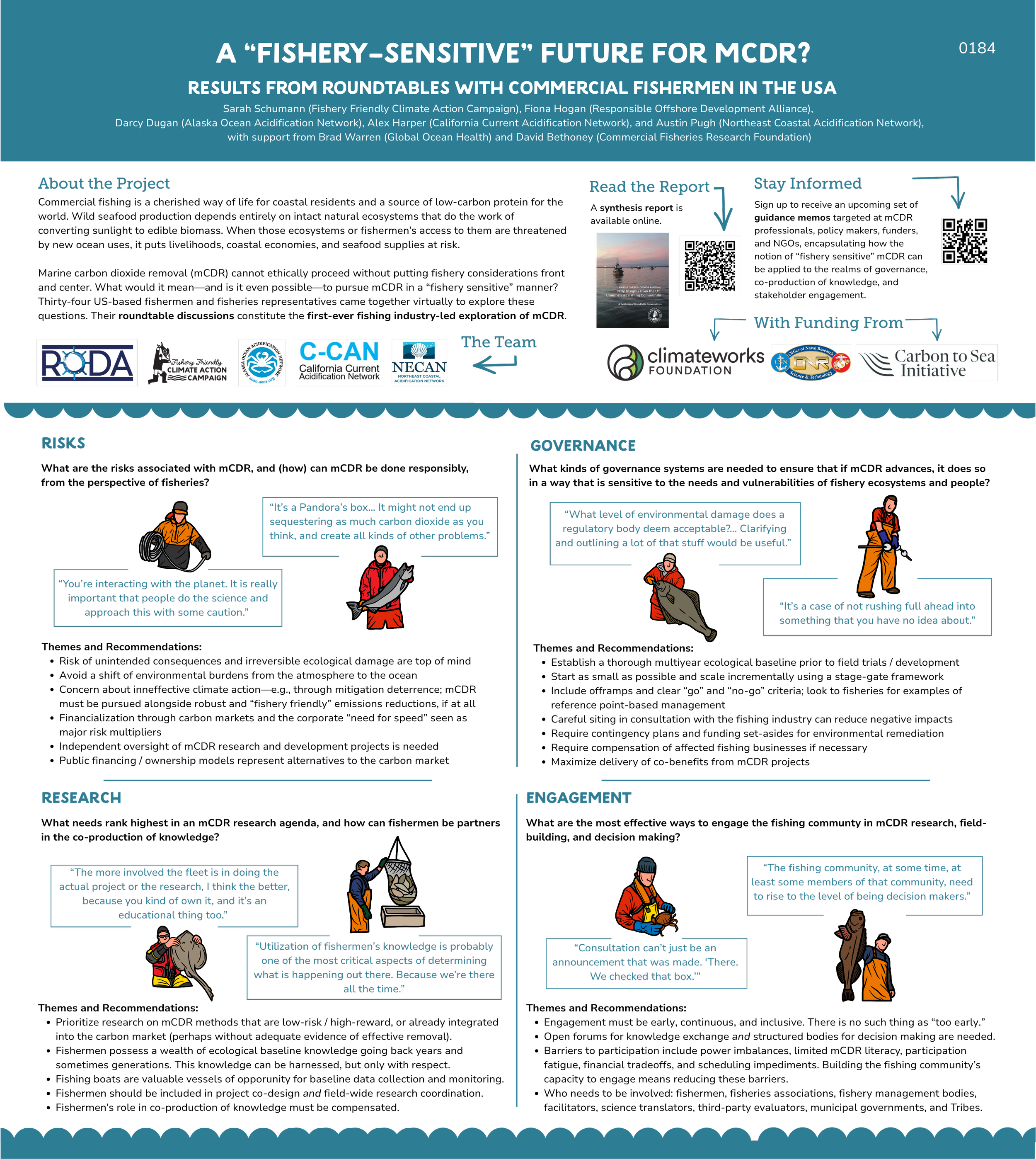
The authors presented this poster at the Ocean Sciences Meeting, based on a set of roundtables hosted through the Fishery Friendly Climate Action Campaign in 2025.
