
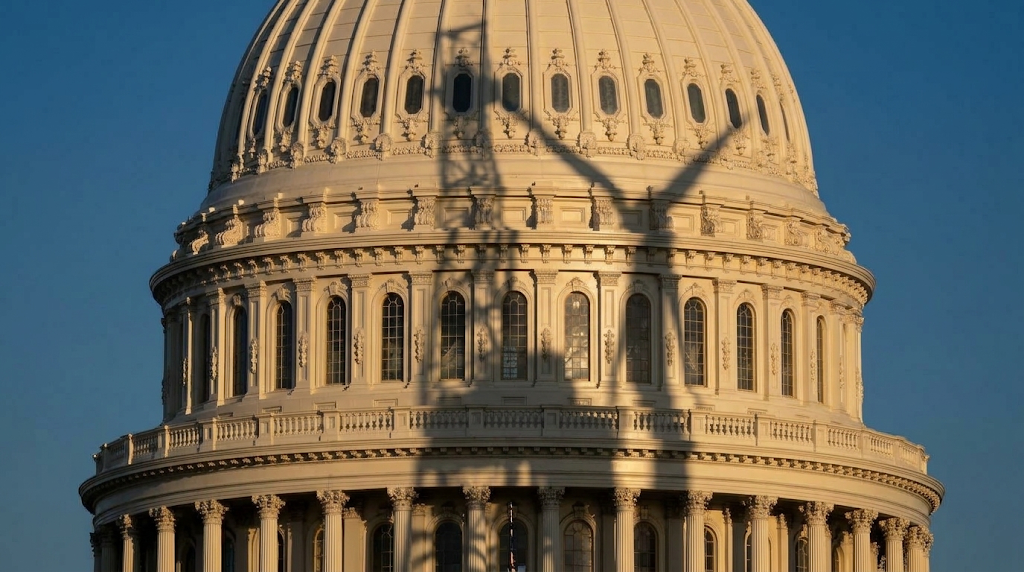
Image created by Noah Oppenheim using AI
By Noah Oppenheim
October 27 — On November 9, the Senate is scheduled to take up the Bipartisan American Affordability and Jobs Act of 2026, known as BAAJA (S. 5653). This legislation is not about Mexican sheep; instead, the dense 400-page bill rewrites how the federal government approves energy, mining, and infrastructure projects. Its sponsors, Senators Shelley Moore Capito (R-WV), Mike Lee (R-UT), Sheldon Whitehouse (D-RI), and Martin Heinrich (D-NM), call it a historic compromise. I call it a historic risk for fishing communities.
The coalition behind BAAJA is unusual. The American Petroleum Institute (oil and gas), the American Clean Power Association (wind and other renewables), and major organized labor groups support it. Tribal nations, historic preservation groups, and ocean conservation organizations oppose it.
Commercial fishermen have been mostly absent from this fight, and that needs to change. BAAJA rewrites the rules for offshore wind farms, export cables, offshore oil and gas, and seabed mining. It changes how those projects are approved, how long the approvals last, and how hard they are to challenge. Nearly every change reduces the leverage fishermen have used to protect fishing grounds historically, and that’s not a coincidence.
The Senate outcome is close to being settled. The House is a different story, and that is where fishermen still have a real opening. But we must make our voices heard, and soon.
What this issue is about
Fishermen have spent more than a decade fighting for a real voice in offshore wind decisions. Lease areas have been granted on productive fishing grounds over industry objections, and project layouts have been set with little regard for how fleets actually fish or what they need for safe transit. Too often, fishermen's concerns have been treated as a box to check rather than a reason to change course.
BAAJA would shrink what voice fishermen have left in the regulatory process for energy permitting. Its supporters pitch it as protection for clean energy, pointing to the 2025 federal stop-work orders that halted offshore wind projects already holding permits. The bill delivers that protection by making permits nearly impossible to revisit once they are issued, and much harder to challenge before then during the planning process.
The bill doesn't stop at wind. Its "protections" for energy projects from public scrutiny and challenge cover any federally permitted project with a private sector sponsor, including offshore oil and gas wells and mines. The same rules that would wall off a wind farm from fishermen's objections would wall off an offshore drilling lease or a seabed mining permit.
More on that in just a bit.
People who work on the ocean deserve a real say in what happens to it, before a permit is issued and after. Whatever the energy source, BAAJA moves decisions further away from coastal communities and closer to developers and their lawyers and lobbyists.
Permits that can't be revisited
Section 1401 of the BAAJA is the real menace, although there are other problems. This language bars federal agencies from revoking, suspending, amending or altering any federal permit held by a private project sponsor. It applies to every permit in effect on or after September 16, 2026, two weeks before the bill was even introduced. For offshore wind, that covers the lease, the construction and operations plan, the biological opinion and the Marine Mammal Protection Act-mandated incidental take statement. Those are the documents that decide where turbines stand and what protections apply to whales and ocean habitat, including Essential Fish Habitat and related considerations.
The bill allows only five exceptions:
● A court orders the change
● The permit holder breaks the terms of the permit or the law
● The permit was obtained through fraud
● The permit applicant or holder asks for the change
● An urgent, specific harm to "life, property, national security, or defense" shows up in new information
Neither fish stocks nor protected species appear on the list of exceptions, so no action would be triggered to require a project to change despite any future impacts to fishing or, for example, marine mammal impacts from a project that might result in constraints to fisheries. An agency that wanted to adjust turbine spacing or add seasonal restrictions would have no clear authority to do it, and the fishing industry would have limited opportunity to engage except using costly litigation, which is also harder to pursue under this bill’s framework.
If an agency acts anyway and loses in court, the developer recovers delay costs, attorney fees, and 25 to 50 percent of everything spent on the project to date. That money comes from the Treasury's Judgment Fund, with no appropriation from Congress required. No agency will take that risk lightly, which means agencies that might see reducing project impacts to fisheries as a part of their mandate suddenly have fiscal and political headwinds they’re unlikely to overcome.
Paying developers when approvals slow down
Section 1402 goes a step further with the "protection" provisions mentioned earlier. It lets developers sue the federal government for "disparate treatment" if an administration deliberately approves their type of project less often than it did over the previous five years. The bill lists 46 project types. Offshore wind, offshore transmission, offshore oil, offshore gas and hardrock mining are all on it.
A developer who wins can collect between 50 and 100 percent of the project's total expected construction cost, on top of other damages and legal fees. For an offshore wind farm, construction costs run into the billions of dollars. Like the Section 1401 awards, these payments come from the Judgment Fund without any appropriation.
The bill sets real hurdles. A developer has to show a statistical pattern, prove it was intentional, and show the pattern lasted at least 180 days after the bill became law. But the threat alone shapes behavior. Imagine a future administration that decides to slow new offshore leasing in a region while fisheries conflicts and cumulative impacts get sorted out. It would be inviting billions in claims, paid by taxpayers, including the fishermen whose grounds are at stake.
Now imagine how many oil and gas projects a future administration would have to issue in order to avoid litigation under this provision. It's hard to believe, but this bill effectively allows project developers to hold the federal treasury hostage until they get the permits they want.
A one-word change with profound impact
One of the bill's most important fisheries-related provisions is also the easiest to miss. The Outer Continental Shelf Lands Act governs offshore wind leasing. It requires the Interior Department to ensure that offshore wind activities provide for "prevention of interference with reasonable uses" of the ocean. Commercial fishing is the most obvious reasonable use there is, and fishing groups have relied on this language when challenging wind approvals.
Section 2251 rewrites that standard. BOEM would only have to provide for the "prevention of unreasonable interference with other uses,” which shifts the standard completely. Under current law the question is whether a project interferes with fishing. Under BAAJA, the question becomes whether interfering with fisheries is unreasonable, and we all know how permitting agencies feel about that. In fact, this language enshrines energy development as the preeminent use of ocean space, anywhere a project applicant wants to site something. To me, that is absolutely unacceptable.
This section weakens the most direct legal protection fishermen have on the Outer Continental Shelf, and it deserves a public debate, which has not happened.
Cables through sanctuaries
Every offshore wind farm needs export cables to bring power ashore, and BAAJA opens new territory for them in a manner that reduces fishing industry oversight. BOEM currently has no authority to grant offshore wind rights-of-way inside National Marine Sanctuaries. Section 2251 creates an exception for transmission lines. NOAA would be consulted, but under the sanctuary law's consultation process it can recommend alternatives, not block a route. Any sanctuary permit for the cables would then run as long as the right-of-way itself, overriding the normal sanctuary permit term.
Sanctuaries such as Stellwagen Bank in Massachusetts Bay and the Farrallones and Cordell Bank in California are among the few places where fishing communities have had a lasting voice in how the seabed is used. Cable trenching, rock armoring and crossings on productive bottom are real costs to those fisheries.
Section 2252 goes further. It directs the Department of the Interior and the Department of Energy to designate preferred routes for offshore transmission cables nationwide within two years, and to revisit them every three years. Rights-of-way along those routes could be issued without competition or constraint. The agencies must "take into account" impacts on other ocean users, "including fisheries." But the only coordination the bill requires is with other federal agencies, not industry or coastal communities.
The regional fishery management councils, coastal states and the fleets that operate within sanctuaries have no defined role in this new process. Fishermen have decades of data on where they fish and when, and that data could make these routes far better. Under this bill, nobody is required to ask for it or consider it, and history shows that they likely wouldn't.
Narrower reviews, frozen science
For fishermen, the environmental review under the National Environmental Policy Act (NEPA) has been the main place to shape an offshore project before it is approved. That is where fleets push for wider turbine spacing, open transit lanes, or a layout that avoids key fishing grounds. BAAJA narrows that opening in several ways.
● Developers dictate the menu. Agencies must drop any project alternative that doesn't fulfill the project's purpose and "meet the goals" of the developer. A layout with fewer turbines or a smaller footprint could be ruled out because it produces less power than the developer wants.
● Science stops cold at the permitting starting gun. No agency would have to consider research published after project review formally begins. Offshore wind reviews take years. New stock assessments, habitat surveys or whale distribution studies published during that time would simply be ignored.
● NOAA is boxed in. As a cooperating agency, NOAA Fisheries would be bound by the lead agency's purpose and need. Its comments would be limited to its own legal jurisdiction, and it could consider only the alternatives the lead agency has already accepted rather than condition a project in any meaningful way.
● Shorter comment opportunities. The scoping comment period on a new environmental impact statement would be capped at 45 to 60 days, or 75 days if the developer agrees to more.
● “Stakeholder outreach” that can't be questioned. Developers would file a "record of stakeholder engagement" of no more than 20 pages, summarizing their outreach to local communities. The bill bars any legal claim based on what that record leaves out or what developers fail to address. Fishing industry concerns would be reduced to a forgettable little section with no actual bearing on the process.
Taken together, these changes mean a fishing community that engages in good faith could do everything right and still never see its concerns studied or addressed.
150 days to get to court
Today, a fishing association generally has six years to challenge a federal project approval. Under BAAJA, it would have 150 days. That limit applies to any lawsuit, under any federal law, against an approval for an energy or mining project, including Outer Continental Shelf leases and plans. It covers claims under the Endangered Species Act and Marine Mammal Protection Act, not just NEPA.
For NEPA challenges, the bill adds more conditions:
● Only a party that filed a comment detailed enough to flag the specific issue may sue on it.
● The plaintiff must show "direct harm."
● Cases go straight to a federal appeals court, skipping the district court where evidence is usually developed.
● Courts must give the agency "substantial deference."
The biggest change comes at the end of a case. If a court finds that an environmental review was illegal, its only remedy is to send the approval back to the agency to fix within 180 days. The permit stays in force and construction continues the whole time. Courts could no longer pause a project over a flawed NEPA review.
Many of our fishing associations operate on shoestring budgets. Under these new rules, they would need to track every comment period on every project, get every argument on the record the first time, and file within five months. Large developers with full-time legal teams will have no trouble meeting those terms.
States lose leverage nearshore
Every export cable crosses state waters on its way to land, and that requires a water quality certification from the state under Section 401 of the Clean Water Act. Coastal states have used that review to protect shellfish beds, nursery grounds and nearshore fishing areas from dredging and cable work.
BAAJA limits states to conditions they can justify by "clear and convincing evidence." Each condition must also be the "least burdensome" option for the developer. A state that misses its review deadline loses its say entirely, and that waiver can't be challenged in court. Conditions tied directly to water quality standards, such as protecting designated shellfish harvesting areas, should survive. Conditions aimed at fishing access, construction timing around spawning seasons, or broader habitat protection will be much harder to defend.
What to ask the Senate
The Senate vote is scheduled for November 9, in the lame-duck session after the midterms. The White House and Senate Republican leaders back the deal alongside its Democratic sponsors, and stopping it there is unlikely. In the Senate, the realistic goals are to improve the bill where possible and to put fisheries concerns on the record.
● Call both of your senators. Ask them to support floor amendments that protect fisheries, using the fixes listed in the next section.
● Ask for a statement on the record. Coastal senators, including the bill's own sponsors, can state during floor debate that Section 1401 isn't meant to stop agencies from protecting fish stocks and protected species when new information emerges. Statements like that can matter later when courts interpret the law. Senator Whitehouse, who is aggressively promoting this bill, represents Rhode Island and its Point Judith fleet, so his voice on this would carry weight.
● Ask the direct question. If amendments fail, ask your senators to explain publicly how the bill protects fishing communities. Senators who have to answer that question are more likely to push for fixes if the House changes the bill and sends it back.
What to ask the House
The House is where fishermen can still change this bill. Representative Jared Huffman, the top Democrat on the Natural Resources Committee, has said most House Democrats won't support it as written. He has warned that its damages provisions could pay developers out of the Judgment Fund without ever getting projects built. Members of the House Freedom Caucus may also object, for their own reasons. Natural Resources Chair Bruce Westerman welcomed the deal, and Speaker Johnson and Minority Leader Jeffries haven't said how they will handle it.
That uncertainty is an opening. Members who are on the fence need to hear from the people whose livelihoods are on the line, and coastal members of both parties represent fishing ports. Ask your representative to oppose the bill unless it includes these fixes:
Let agencies act on new fisheries science. Add harm to fish stocks, fish habitat and protected marine species to the Section 1401 exceptions, so offshore permits can be adjusted when new data shows a problem.
Keep the reasonable-uses standard. Strike the Section 2251 change to the Outer Continental Shelf Lands Act and keep the requirement to prevent interference with reasonable uses of the ocean.
Give fishermen a seat in cable planning. Require Interior and the Department of Energy to consult the regional fishery management councils, coastal states and fishing fleets, and to use fishing effort data, before designating cable routes. Require sanctuary advisory councils to weigh in before any cable crosses a sanctuary, and retain NOAA permitting oversight of cables in sanctuaries.
Don't penalize caution. Remove offshore project types from the Section 1402 damages provisions, or make clear that slowing approvals to resolve fisheries or protected species conflicts isn't “disparate treatment”. [And by the way, it’s super weird to see civil rights language (“disparate treatment”) applied to multinational corporate energy developers].
Keep the science current. Exempt fisheries and protected species research from the cutoff on new science for offshore projects. Let agencies study alternatives that reduce conflicts with existing ocean users, even when those alternatives don't match the developer's goals.
Keep the courthouse door open. Don’t cut off fishing communities’ opportunity to use their collective voice in court. Let courts pause offshore construction when they find an environmental review was illegal.
How to weigh in: Look up your Member of Congress at house.gov. If you belong to a fishing association, ask it to send a letter to your state's House delegation and to the Natural Resources Committee. Tell them what you fish, where you fish, and what your port depends on. A message from a working fisherman carries more weight than anything an advocacy group can send.
Fishermen have learned the hard way that decisions about the ocean get made whether or not they are in the room. This bill would slam the door shut.
Best of luck to us all.
Noah Oppenheim is the principal of Homarus Strategies based in Brunswick, Maine, where he provides policy analysis, project management, and government relations services on behalf of fishing communities across the country. He has worked on a wide range of issues including offshore wind and other aspects of federal energy policy, working waterfronts, fishery management, protected species, seafood systems, and more. He can be contacted at noah@homarus.co.
