
Carbon to Sea Convening: Sarah’s Remarks
By Sarah Schumann
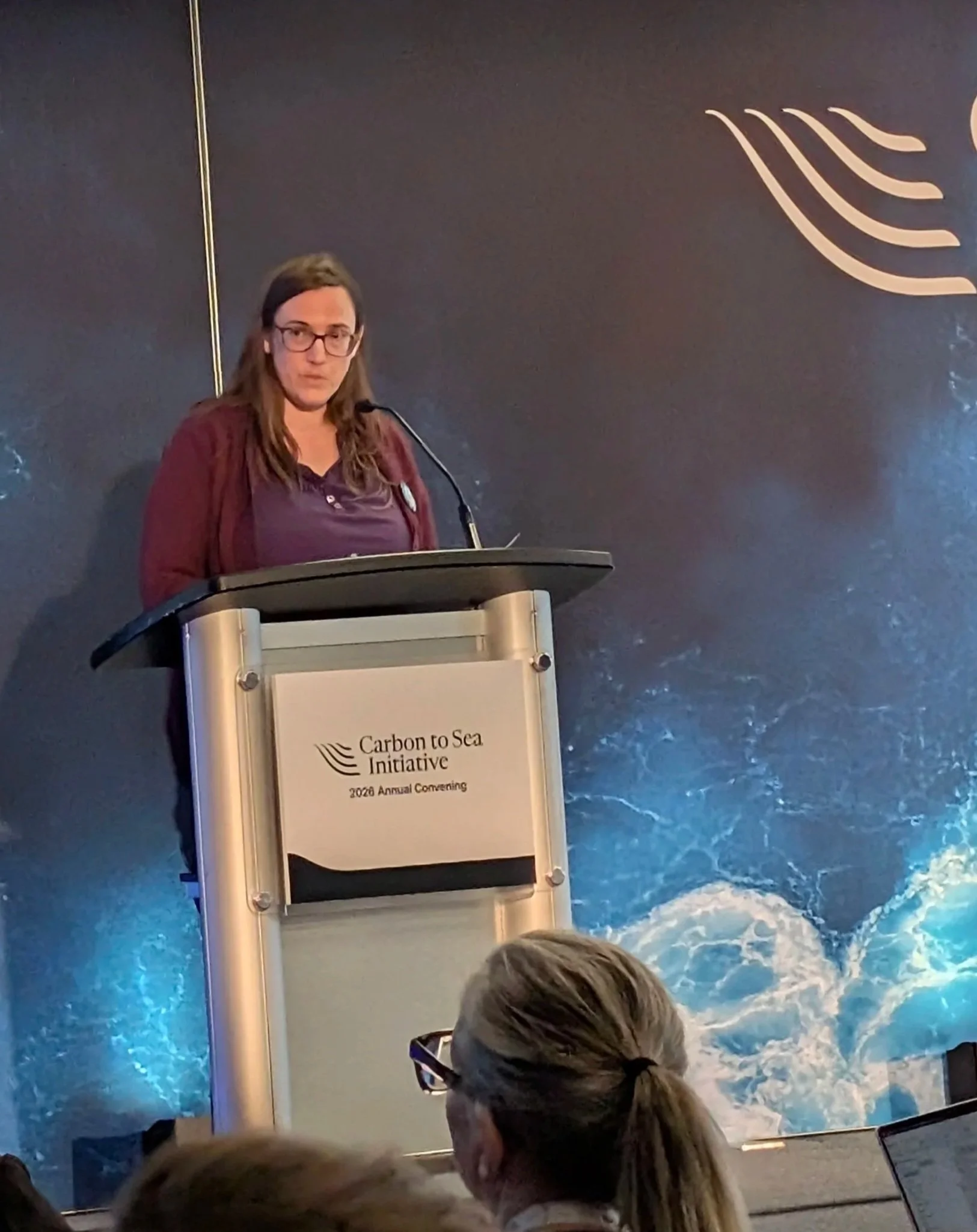
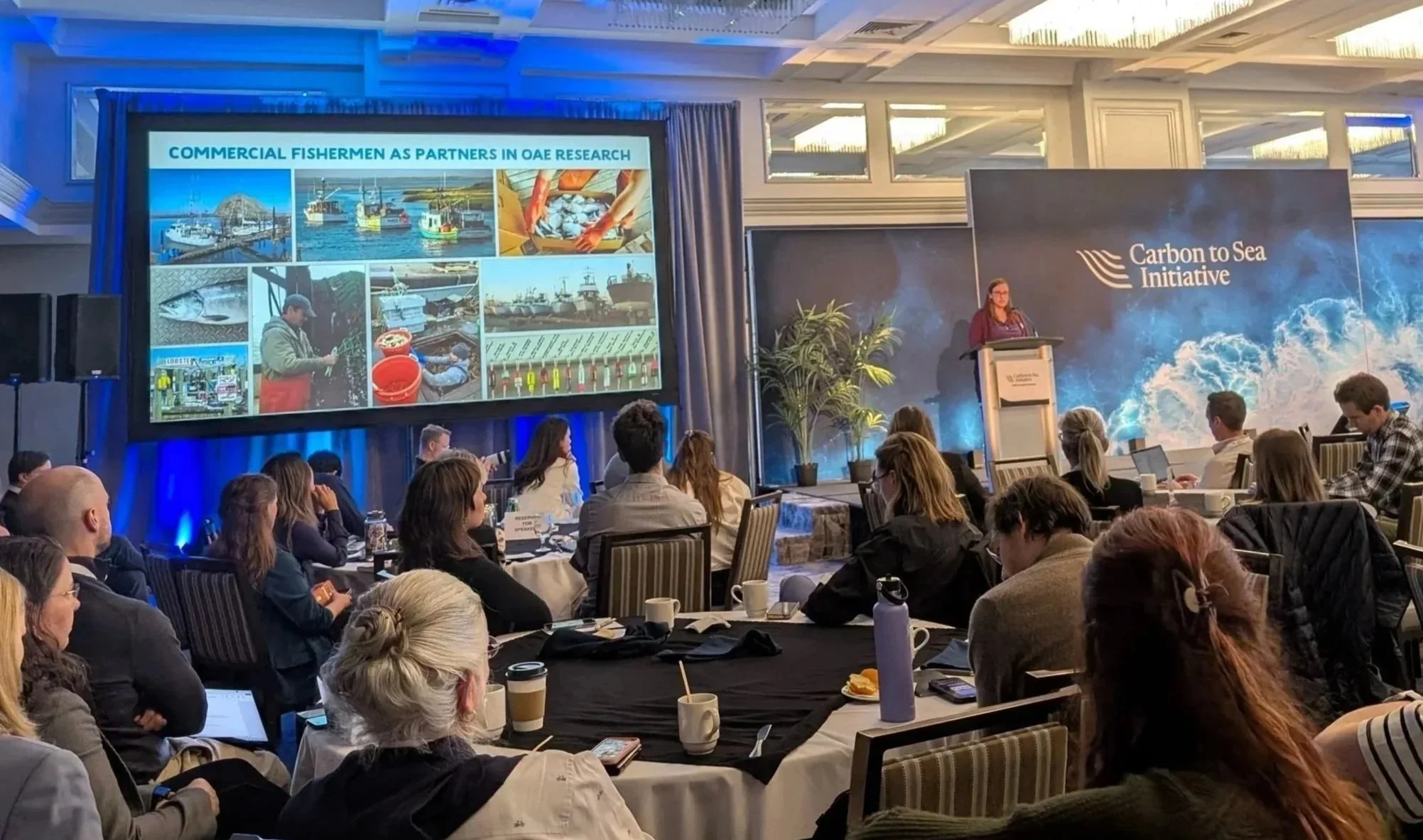
April 29, 2026 — Today, I attended Day One of the Carbon to Sea Initiative’s Annual Convening in Halifax, Nova Scotia, along with a group of other fishermen and fisheries representatives from the US and Canada. I was given five minutes at the podium to talk about Commercial Fishermen as Partners in Ocean Alkalinity Enhancement (OAE) Field Research. These are my remarks.
What I said
I’m Sarah Schumann, I’m a commercial fisherman, and I direct the Fishery Friendly Climate Action Campaign, a bicoastal US-based network that aims to develop the climate leadership of the commercial fishing industry.
Fishermen are on the front lines of climate change. We’re on the front lines of the atmospheric carbon pollution that has made our oceans more acidic by absorbing 30% of the excess carbon dioxide emitted since the start of the industrial revolution. Nowadays, we’re increasingly on the front lines of many of the solutions that are being put forth to remedy the climate crisis by using what the ocean has to offer—including marine CDR and OAE.
That’s why the voices, knowledge, values, and perspectives of fishermen, fishing businesses, fishing families, and fishing communities are so critical to the conversation about how OAE matures.
The tool I want to talk about today is Commercial Fishermen as Partners in OAE Research.
Earlier this morning, we heard about a project—the LOC-NESS field trial—where fishermen played a critical role in making the project more “fishery sensitive”—that is, more attuned to and compatible with the objectives of sustainable fish production and harvesting.
The LOC-NESS team hosted at least six public listening sessions in New England fishing ports and fishery trade shows, four presentations and tabling events at fisheries management meetings, and four private meetings with leaders in the commercial fishing industry.
The input they received through those conversations influenced the timing and location of the field trial and resulted in the inclusion of additional pre-field-trial laboratory testing on zooplankton and the incorporation of neuston net tows into the field trial itself to assess impacts to fish and lobster eggs and larvae.
Lastly, the WHOI team invited me to go along on their field trial as a fishing industry observer and to share notes and photos of the dispersal online, which was a testament to their commitment to transparency and helped me build awareness among the fishing community nationwide.
But the LOC-NESS experience is just the beginning of what it can look like when members of the fishing community help shape an OAE field trial.
Fishing community participation in field research can include:
Establishing a baseline, in which fishermen share their ecological knowledge and their understanding of fishing patterns with the research team to help them design a better project and assess project impacts accurately.
Research co-design, which invites fishermen to play a role in defining research questions, methods, and analyses.
Cooperative research, which invites fishermen to use their boats and their fishing gear in data collection before, during, and after a field trial.
Field trials also need to include fishermen in planning and decision making as well as fact-finding. This should include a two-prong approach that includes:
Broadly informing the fleet to make sure that everyone knows what’s going on and who to take their questions to if they have any; as well as
Formally granting a subset of individuals from the community direct and ongoing roles in shaping a project alongside a research team.
Lastly of course, I think it’s a fantastic idea for all field trials to include a fishing industry observer to report back to the fleet on what takes place and what is learned.
But the most important point that I want to make today is that engagement of fishing-dependent and other coastal communities is just as important in the field-wide conversations that establish future research agendas as it is at within the local research projects that carry out these agendas through empirical work.
That’s why it’s so valuable that Carbon to Sea has made it possible for six members of the North American commercial fishing community to be here today.
Communities that stand to be affected by OAE need to have a say not just in local field trials but also in setting research agendas, defining research standards, informing funding commitments, and crafting the public and private governance frameworks that will shape the future of the OAE field as a whole.
In short: fishermen need to be involved in every aspect of OAE. But how? How can we create structures that enable the engagement and participation of fishing communities without taxing and overburdening them? How can we ensure that fishing community voices are truly heard and have real weight and influence over research that could have impacts on their lives – either directly through field trials themselves or indirectly through the commercial-scale operations that research trials may eventually enable?
Those are the questions I invite you to discuss with the people on this slide, who are all in this room today: Lane Johnston, Beth Casoni, Ginny Boudreau, Antonio Arena, Gord MacDonald, and Helen Gurney-Smith from Canada’s Department of Fisheries and Oceans, who is helping this group make connections here at the convening.
All of us will be here for the duration of this convening, wearing a blue “fishing industry” button like the images on this slide, to make it easy to identify us. Please find us and strike up a conversation. We look forward to getting to know you.
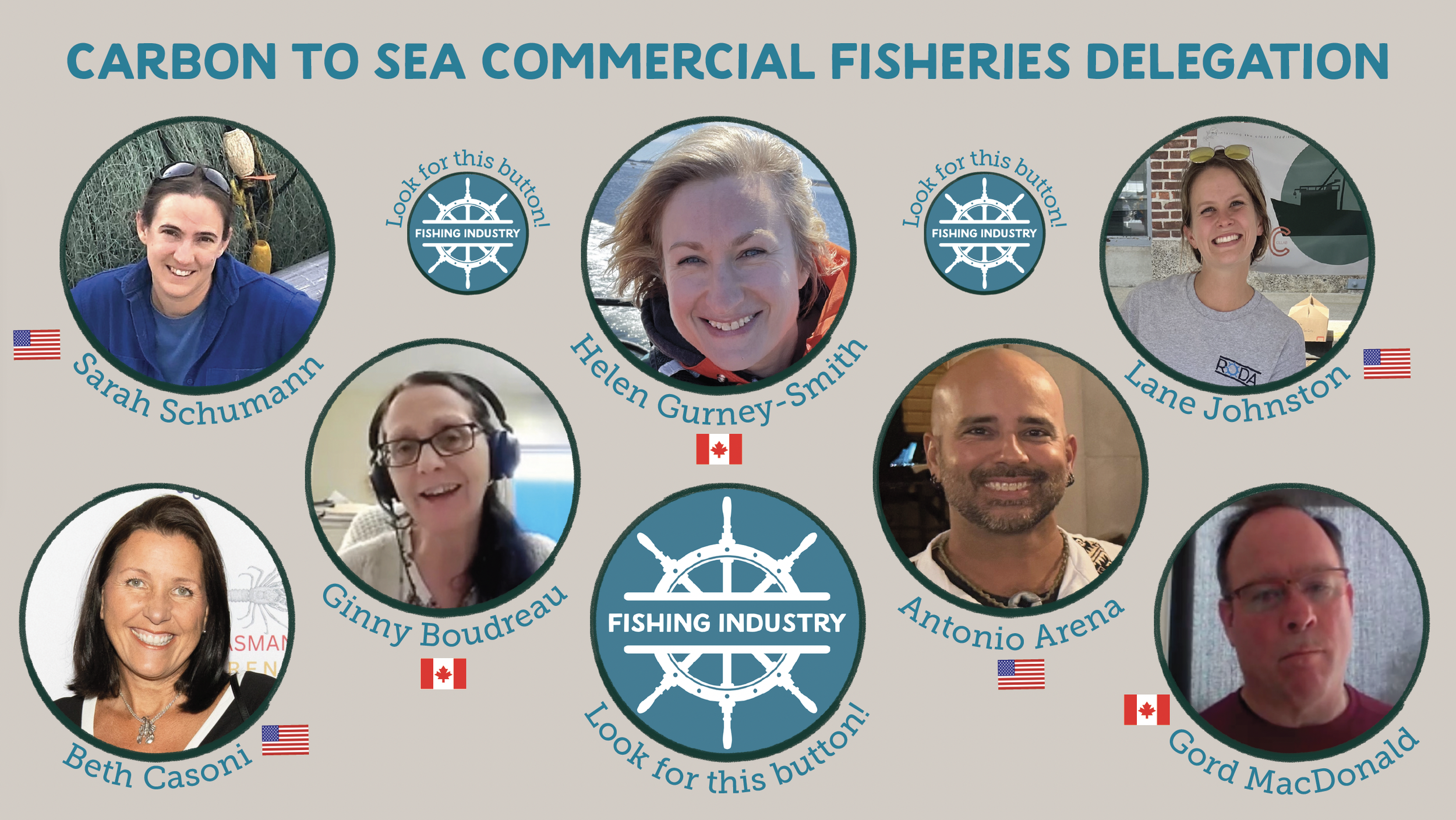
The members of the commercial fisheries delegation to the Carbon to Sea convening, April 28-30, 2026.
