Podcast and Analysis: Lessons from LOC-NESS for the Future of Fishery Engagement in mCDR

Ashley McKinnon researched fisheries engagement in the LOC-NESS field trial.
By Sarah Schumann
April 26, 2026 — Ashley McKinnon is a graduating senior at Brown University (‘26, BS Environmental Sciences and Studies) who completed her thesis research in collaboration with the Fishery Friendly Climate Action Campaign, focused on exploring lessons learned through fishing community engagement in the LOC-NESS ocean alkalinity enhancement field trial undertaken by the Woods Hole Oceanographic Institution (WHOI) in 2025.
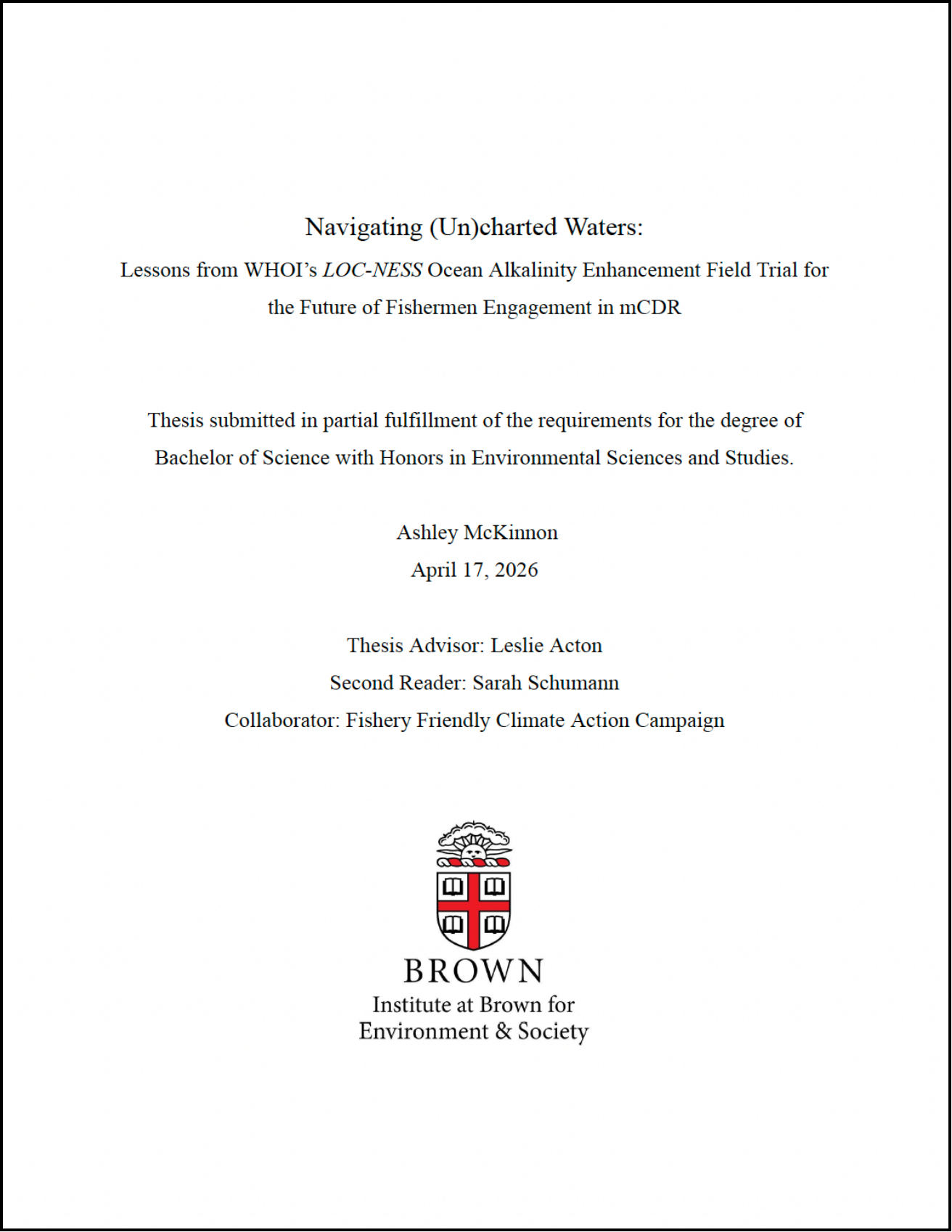
Ashley’s honors thesis, “Navigating (Un)charted Waters: Lessons from WHOI’s LOC-NESS Ocean Alkalinity Enhancement Field Trial for the Future of Fishermen Engagement in mCDR” tells a multifaceted tale of where engagement succeeded, where it fell short, and how it can be improved in future mCDR field trials.
The results of this research are useful for mCDR permitting agencies, mCDR research teams, and members of the fishing industry as they navigate future field trials in their regions and contribute to the development of responsible governance frameworks for mCDR.
Listen to the podcast
In this 30-minute podcast, I interviewed Ashley about her research and what it means for future mCDR field trials.
About the Research
Data Sources
Ashley analyzed 31 public comment statements submitted by fishermen and fisheries representatives to the EPA during LOC-NESS’s permit applications. Then she interviewed twelve fishermen and fisheries representatives who had either submitted comments to the EPA and/or participated in the WHOI team’s community outreach in 2024 and 2025, which included six public listening sessions in New England fishing ports and fishery trade shows, four presentations and tabling events at fisheries management meetings, and four private meetings with leaders in the commercial fishing industry.
Key Themes
Key takeaways emerging from Ashley’s research include:
EPA’s LOC-NESS permit was first time the Marine Protection, Research and Sanctuaries Act (MPRSA) has been used to permit an mCDR field trial; as such, it was a precedent-setting situation that merits careful scrutiny regarding what went well and what could be done better, while also helping illuminate answers to the question: is the MPRSA a sufficient governance framework for mCDR research, or do we need a more purpose-built approach for moving forward?
Fishermen were concerned about the ecological impacts of the field trial both during and after, and how this could impact their industry if it were to be done on a larger scale and taken up by corporations looking to offset their emissions.
Most of the statements submitted to the EPA called for WHOI to not carry out the field trial at all. Others, demonstrating implicit support for a “stage-gate” framework as a paradigm for mCDR research, asked the EPA to only approve one trial at a time. In the end, WHOI did only carry out one trial — partly because of fishermen’s input and partly because of logistical reasons.
Many of the comments submitted by fishermen and their representatives recommended that fish, lobster and squid larva be tested at length in the lab ahead of the trial. The EPA did not implement this recommendation, but the WHOI team voluntarily tested their alkaline solution on phytoplankton and zooplankton in the lab.
Many interviewees tended to see the EPA permitting process as more of a “check the box exercise,” noting that the EPA did not respond to their comments and that there was no evidence of the permit conditions being adapted as a result of their suggestions.
Interviewees would have appreciated some dedicated fishing industry public hearings hosted by the EPA, a practice they note is common in BOEM’s permitting of offshore wind.
Interviewees valued WHOI’s commitment to engaging them, but admitted the fishing industry’s sporadic attendance and sometimes-contentious attitude prevented the fishery listening sessions from being as informative and constructive as they might have been.
WHOI released a statement after the trial that there was “no significant impact” on the microbial community tested, but interviewees requested a clear definition of “significant” given that this may be different to a scientist than it is to a fisherman, adding that monitoring stopped after the dispersal period when impacts could potentially occur farther down the line.
For the future, interviewees recommended diverse fishing industry outreach strategies, including video meetings on Zoom, creation and distribution of a primer on ocean alkalinity enhancement, appointment of a fisheries liaison position to relay between the fishing industry and the research team, incorporation of asynchronous learning and dialogue opportunities into the outreach strategy, and easy-to-complete-from-anywhere input formats such as opinion polls.
Fishermen are scarred from their experiences with offshore wind and have lost trust in governance structures; efforts to advance mCDR will benefit from a thorough understanding of what went wrong with offshore wind and how to avoid repeating those dynamics. mCDR is a novel area and there is still time to set the governance and engagement expectations differently.
Interviewees underscored their sense of confusion around mCDR and requested user-friendly educational materials to help them navigate these “uncharted waters.”
Conclusions
Overall, while giving credit to the WHOI team for integrating fisheries engagement into their project voluntarily, Ashley’s research points to the need for fisheries engagement to be mandated by formal governance rules, such as through federal legislation:
The LOC-NESS case demonstrates that while early engagement with fishermen is possible, structural barriers – particularly from the regulatory process and distrust from OSW and historical exclusion – continue to limit meaningful participation in decision-making. However, there is hope that the regulatory process changes to enforce stakeholder engagement so that research teams such as WHOI are not entirely responsible. Outreach by research teams on fishermen’s perspectives on mCDR is not currently mandatory – WHOI engaged out of an understanding that fishermen’s input could improve their project. The Rescue Oceans Act or another similar bill has the ability to make this engagement more formalized and enforced by the EPA so that fishermen’s voices are less likely to be marginalized as they have been historically.
Read the Thesis
RESEARCH QUESTIONS
What perceptions and lessons can be learned from fishing community participation in the EPA permitting process under the Marine Protection, Research, and Sanctuaries Act (MPRSA)?
What perceptions and lessons can be learned from fishing community participation in the LOC-NESS public engagement process, and how should they inform future mCDR governance?
What lessons from the fishing community’s prior experiences with offshore wind development and engagement are transferable to mCDR governance?