

Blog
Spotlighting fishermen-led climate action from coast to coast

Post-field trial debrief with the LOC-NESS science team
Sarah Schumann caught up with two of the lead scientists of WHOI’s LOC-NESS ocean alkalinity enhancement field trial in the Gulf of Maine: Adam Subhas and Jennie Rheuban. She was curious to hear how the experiment went from their standpoint, what kind of data they had collected, and what preliminary results they were ready to share from the field trial.
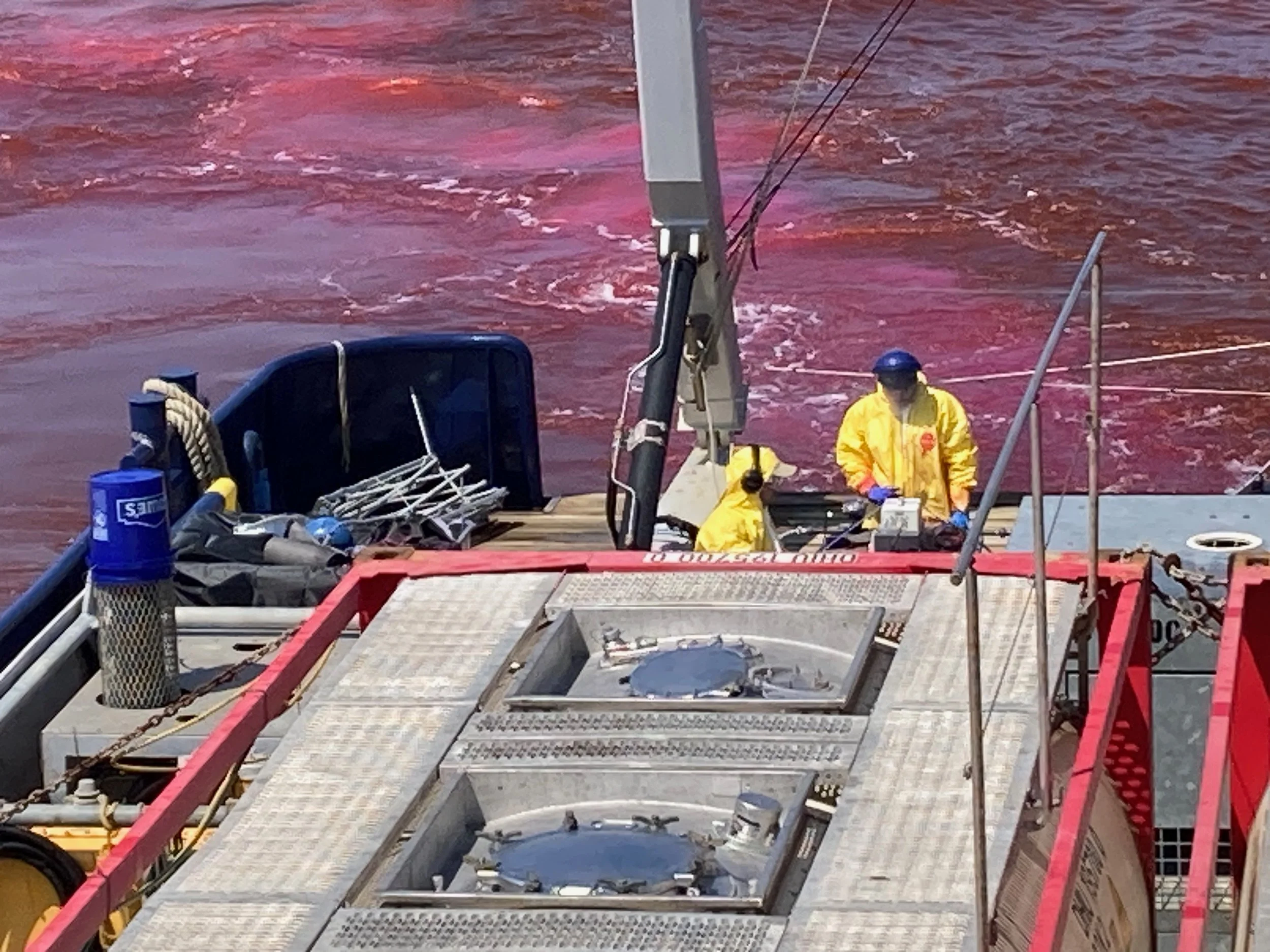
A fisherman bears witness to WHOI’s alkalinity experiment in the Gulf of Maine
Sarah Schumann was a fishing industry observer on the August 2025 LOC-NESS ocean alkalinity enhancement field trial in the Gulf of Maine, in which WHOI engineers released 16,500 gallons of sodium hydroxide solution dyed with rhodamine tracer into surface waters to assess potential for carbon removal. Read her field notes here.
Maine Coast Dock Talk: Understanding WHOI's LOC-NESS Project (link to podcast)
This is a link to the Maine Coast Dock Talk podcast. In this episode of the Maine Coast Doc Talk podcast, produced by the Maine Coast Fishermen’s Association, host and executive director Ben Martens chats with Dr. Adam Subhas of the Woods Hole Oceanographic Institution to explore the research initiative known as the LOC-NESS project. LOC-NESS stands for Locking Ocean Carbon in the Northeast Shelf and Slope and is testing the safety and effectiveness of ocean alkalinity enhancement to combat climate change.

Fishermen’s reflections: How to make mCDR research and development “fishery sensitive”?
At our May 28 webinar on “Marine Carbon Dioxide Removal: What Fishermen Need to Know,” a panel of four commercial fishermen and fisheries representatives reflected on their participation earlier this spring in a set of roundtables hosted through the Fishery Friendly Climate Action Campaign to support this project.

Marine carbon dioxide removal: How fishermen can have a voice
This is an excerpt from an article published in National Fisherman. This article is the second in a series for commercial fishermen about marine carbon dioxide removal (mCDR). mCDR is a set of experimental techniques that could someday play a major role in combating climate change by accelerating the ocean’s uptake and storage of heat-trapping carbon dioxide pollution from the atmosphere.

Marine carbon dioxide removal: What fishermen need to know
This is an excerpt from an article published in National Fisherman. Marine carbon dioxide removal (mCDR) is a set of experimental techniques that aim to accelerate the ocean’s uptake and storage of heat-trapping carbon dioxide pollution from the atmosphere. Someday, these techniques could play a major role in combating climate change. mCDR is not yet a major subject of fishermen’s daily dock talk, fishing association newsletters, or industry trade shows, but it’s time we make it one.

Ocean Visions Summit, Day Three: What’s Next?
The final day of the Ocean Visions finished with a plenary session where panelists and audience members took turns at the mic to reflect on the three-day experience and share their visions for what comes next. A number of these comments focused on the fourth pillar of the Ocean Visions network’s agenda to confront the ocean-climate crisis: Reach. Ocean Visions recently added its “Reach” pillar to the other three pillars in its strategy (Remove, Repair, and Reduce) to ensure that “a wide array of diverse perspectives and backgrounds are fully engaged in pursuit of solutions.”

Ocean Visions Summit, Day Two: Moving from “Engagement” to “Agency”
As the field of marine carbon dioxide removal (mCDR) jumps from the laboratory into the field, can it advance in a way that avoids crushing coastal communities? That was the unspoken question at the heart of a panel discussion on “Working with Communities at the Ocean-Science Nexus” at the Ocean Visions Summit in Vancouver, BC earlier this week.

Ocean Visions Summit: Day One
I came here on a reconnaissance mission to understand one particular set of ocean climate solutions: those categorized as marine carbon dioxide removal, or mCDR. Who is leading the charge on mCDR, how fast is the field moving, and what key governance and engagement onramps exist for injecting fishing community priorities into the conversation?

Webinar Recap: The “Transition to a Low Carbon Fishing Fleet” Initiative — A Tour of Recent Publications and a Preview of Next Steps
Thank you to everyone who joined the webinar on January 23 about “The “Transition to a Low Carbon Fishing Fleet” Initiative: A Tour of Recent Publications and a Preview of Next Steps”!

Partnership with National Fisherman: Apply for Steering Committee by February 10
In the next year, writers at National Fisherman will be working with a ten-member steering committee convened through the Fishery Friendly Climate Action Campaign to produce a 20-article series on energy efficiency and next-gen power sources for fishing vessels.

Fellowship for emerging leaders: Apply by February 10
“Leadership is accepting responsibility for enabling others to achieve shared purpose in the face of uncertainty.” Despite the seeming might of the world’s Goliaths, “David sometimes wins.” Learn these and other lessons in a new fellowship for emerging New England fisheries leaders.